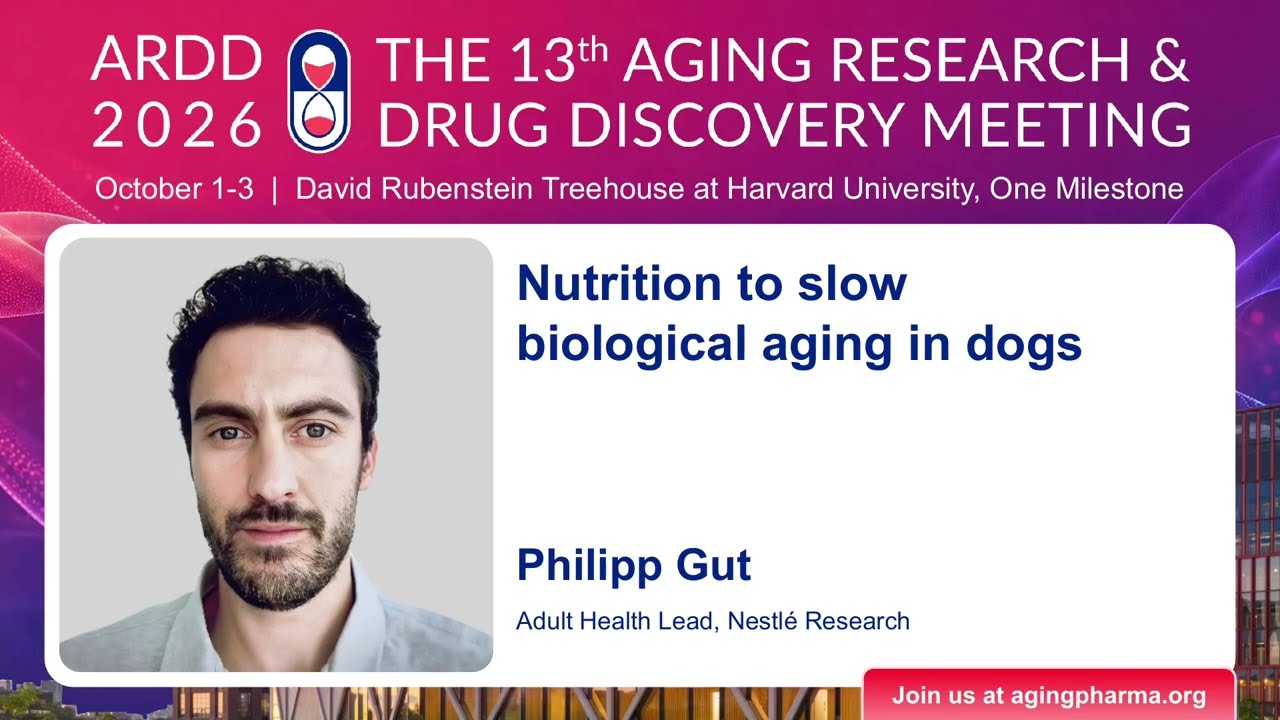
Philipp Gut at ARDD2026: Nutrition to slow biological aging in dogs
Title history
- Philipp Gut at ARDD2026: Nutrition to slow biological aging in dogs — observed on 20261027-1621 UTC (YouTube)
Keywords
Summary
197 words
Critical Evaluation
Value of the Information & Strength of the Argument
The value of the information lies in presenting novel data on aging biomarkers specifically for dogs, which is a relatively underexplored area. The argumentation is supported by several studies, including a long-term calorie restriction trial and collaboration with the Morris Animal Foundation. The speaker demonstrates the utility of both phenoage and epigenetic clocks in predicting mortality and health outcomes, and shows their responsiveness to dietary interventions. The reasoning is logical and well-structured, moving from concept to validation to application. However, the talk relies heavily on unpublished data and does not provide full methodological details or statistical significance thresholds, which limits the strength of the conclusions. The mention of collaboration with Steve Horvath adds credibility, but the overall persuasive power is moderate due to the lack of peer-reviewed evidence.
Scientific Rigor, Source Quality, Title Accuracy
The scientific rigour is generally high, as the speaker presents data from controlled studies and uses established methods like DNA methylation and phenoage. The sources are primarily internal Nestlé studies and collaborations, which are not fully disclosed. The title is perfectly aligned with the content, focusing on nutrition and aging in dogs. The talk does not cite external publications in detail, but references Steve Horvath’s work and the ARDD conference. The lack of references in the description to primary literature reduces the auditability of the claims. Nevertheless, the methodology appears sound, and the use of biobanked samples and longitudinal data strengthens the reliability. No comments were provided for analysis, so no public sentiment can be assessed.
259 words
Title / Content Match
The title accurately reflects the content: a talk by Philipp Gut on nutrition to slow biological aging in dogs.
Quality & Reliability
7/10
Presentation of original research with data on phenoage and epigenetic clocks in dogs, but limited external validation and no peer-reviewed publication yet.
Key Moments
Markers derived by PSI from the transcript: the creator did not define chapters.
- Introduction and anecdote about Steve Horvath's passion for science.
- Discussion on translational research between human and pet health, including an example with probiotics.
- Presentation of phenoage clock development and validation in dogs.
- Validation in Morris Animal Foundation cohort and impact of overweight on biological age.
- Introduction to epigenetic clocks using EMC technology and breed classification.
- Summary and Q&A regarding clinical trials and future directions.
Cited Sources
- ARDD (Aging Research and Drug Discovery) Website — Official conference website providing information about the meeting and sponsors.
- Aging Pharma LinkedIn — LinkedIn page for updates on ARDD and related events.
Contribution & Novelties
This talk contributes original data on the development and validation of biological aging clocks specifically for dogs, including both phenoage and epigenetic clocks. It demonstrates that these clocks are responsive to dietary interventions such as calorie restriction and weight loss, making them practical endpoints for longevity trials. The alignment of these clocks with morphological and health outcomes in dogs offers a unique model for understanding aging and translation to humans. The talk also highlights the potential of using conserved genetic regions to create cross-species clocks.
Pour aller plus loin :
- Epigenetic clock — A type of biological clock based on DNA methylation levels, central to the presented research.
- Calorie restriction — The dietary intervention used in the long-term study that validated the clocks.
- Biological age — Conceptual background for the biomarkers discussed.
- DNA methylation — The molecular mechanism underlying epigenetic clocks.
141 words
Radar Profile
The radar profile shows a strong technical level and quality of information, but moderate scores in quantity and reliability. This reflects a presentation with substantial scientific depth but limited external verification and public engagement.