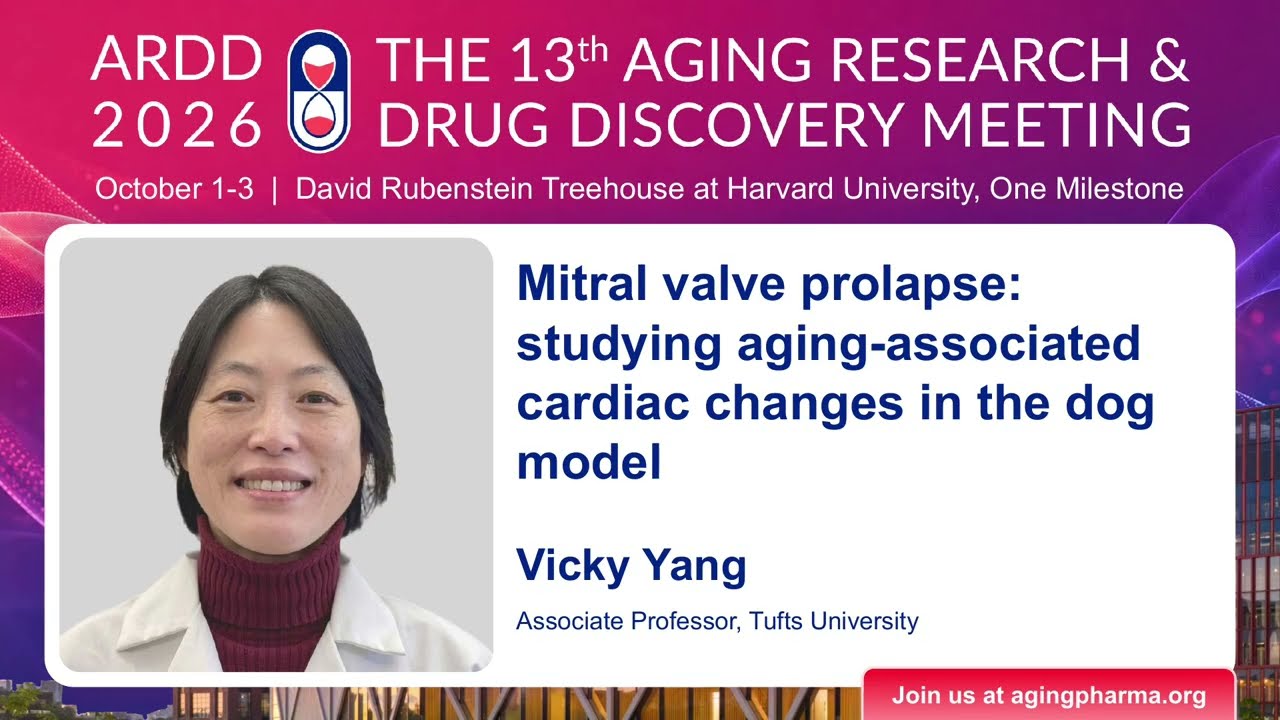
Vicky Yang at ARDD2026: Mitral valve prolapse
Title history
- Vicky Yang at ARDD2026: Mitral valve prolapse — observed on 20261027-1436 UTC (YouTube)
Keywords
Summary
160 words
Critical Evaluation
Value of the Information & Strength of the Argument
The presentation is highly valuable for bridging veterinary and human cardiology, offering a naturally occurring animal model that closely mirrors human MVP. The argumentation is solid: the speaker systematically builds a case from clinical observations to molecular mechanisms, using a combination of imaging, histology, and in vitro experiments. She clearly states current knowledge gaps and supports her hypotheses with data, such as increased IBA1 and CD206 staining in disease valves and differential miRNA expression. The positive feedback loop hypothesis is well-argued, though some steps are inferential. The discussion of therapeutic opportunities is pragmatic, acknowledging challenges like off-target effects of MEK inhibitors. Overall, the reasoning is coherent and evidence-based, though the presentation time limits deep exploration of each claim.
Scientific Rigor, Source Quality, Title Accuracy
The talk demonstrates scientific rigor through the use of well-established techniques (echocardiography, IHC, miRNA analysis) and references prior work (e.g., genetic studies, mouse models). The speaker discloses that some data are unpublished and acknowledges limitations (e.g., inability to control environment in dogs). The sources cited are primarily the conference organization links (agingpharma.org and LinkedIn), which are not scientific references but point to resources for further information. The title accurately represents the content, with no mismatch. The transcript is detailed and technical, and the speaker appropriately answers questions, showing awareness of alternative theories. No external sources are explicitly cited in the talk, but the description provides the conference platform. Considering the context, the 8/10 reliability score is justified.
250 words
Title / Content Match
The title accurately reflects the content: the speaker discusses mitral valve prolapse in the context of aging, using a dog model, and presents her research findings.
Quality & Reliability
8/10
The presentation is grounded in original research data, including histology, echocardiography, and molecular analyses (IHC, miRNA sequencing), presented by a veterinary cardiologist at a specialized conference. The scientific claims are supported by concrete experimental observations and reference to prior work, though the talk is a conference presentation and not peer-reviewed in this form.
Key Moments
Markers derived by PSI from the transcript: the creator did not define chapters.
- Introduction to mitral valve prolapse (MVP) and its impact on dogs, with comparison to human disease.
- Presentation of echocardiographic examples and the progressive nature of the disease, from murmur to heart failure.
- Discovery of M2 macrophages in diseased valves using IBA1 and CD206 markers, suggesting inflammatory involvement.
- Discussion of microRNA findings: miR-145 and miR-125b in EVs and their role in fibroblast activation.
- Therapeutic strategies targeting macrophage-fibroblast crosstalk and the challenge of drug specificity.
- Introduction of a novel slice culture model for cardiac tissue and its advantages for drug testing.
- Q&A covering genetic links, macrophage origin, and the effect of anti-cancer drugs on heart valves.
Cited Sources
- ARDD 2026 Conference Website — Official page for the Aging Research and Drug Discovery meeting, where this talk was presented.
- ARDD LinkedIn Page — Company page for ARDD, providing updates and context on the conference.
Contribution & Novelties
The presentation provides a novel integration of established concepts (macrophage-fibroblast crosstalk) into the context of canine MMVD, highlighting the translational value of the dog model. The identification of M2 macrophages and specific miRNAs (miR-125b, miR-145) as drivers of fibrosis offers potential new therapeutic targets. The slice culture system is an innovative methodological advance for studying cardiac tissue. The talk emphasizes the importance of aging and inflammation, challenging the classic view of MVP as purely mechanical.
Pour aller plus loin :
- Mitral valve prolapse — Relevant to the clinical aspects and epidemiology of the human condition.
- Myxomatous mitral valve disease — Directly related to the canine disease discussed.
- Macrophage polarization — Provides background on M1/M2 macrophage phenotypes and their roles in fibrosis.
- Extracellular vesicles — Context for the signaling packets mentioned in the talk.
- TGF-beta signaling pathway — Background on the pathway implicated in fibroblast activation and fibrosis.
147 words
Radar Profile
The radar profile would show high scores in technical level and fiability, with moderate scores in quantity and quality of information. This indicates a technically dense, reliable presentation that provides substantial but not exhaustive information, consistent with a conference talk.