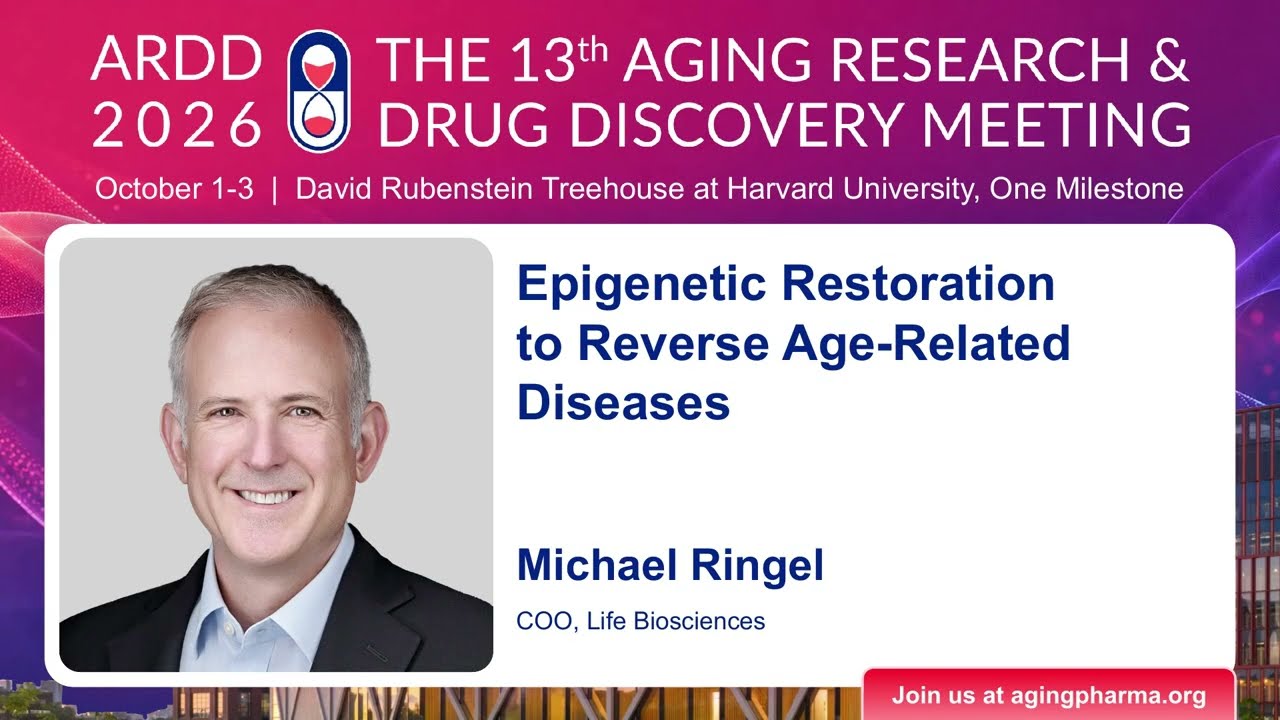
Michael Ringel at ARDD2026: Epigenetic Restoration to Reverse Age-Related Diseases
Title history
- Michael Ringel at ARDD2026: Epigenetic Restoration to Reverse Age-Related Diseases — observed on 20261101-0213 UTC (YouTube)
Keywords
Summary
167 words
Critical Evaluation
Value of the Information & Strength of the Argument
The talk offers substantial value in summarizing the scientific rationale for epigenetic reprogramming, drawing on well-known foundational discoveries (Yamanaka factors, Sinclair lab’s OSK work). The argumentation is logically structured: from natural phenomena to mechanism, then preclinical evidence across species, and finally clinical translation. However, the presentation is inherently promotional, emphasizing positive results while acknowledging limitations superficially (e.g., no long-term safety data in humans). The speaker uses a mix of published studies and company internal data, which reduces independent verification. The reasoning is coherent but may overstate the certainty of the ’logic chain’ between epigenetic changes and functional outcomes, as the speaker himself admits further studies are needed.
Scientific Rigor, Source Quality, Title Accuracy
The scientific rigor is moderate: the talk references key publications (e.g., Nature cover on vision restoration, Church lab lifespan extension) but does not provide direct citations or URLs for these within the video. The sources available in the description are institutional (company website, LinkedIn) rather than peer-reviewed literature. The title accurately reflects the content, and the presentation aligns with the conference’s focus on aging drug discovery. The speaker is credible (former BCG R&D leader, now at Life Biosciences) but clearly represents a company with financial stakes. Overall, the sources are suggestive but not independently verifiable from the video alone, limiting the reliability score.
225 words
Title / Content Match
Title accurately reflects the content: a focused talk on epigenetic restoration to combat age-related diseases, consistent with the company's messaging.
Quality & Reliability
6/10
Presentation at a major aging conference with preclinical data and clinical trial progress, but primarily company-led with potential commercial bias; independent peer-review not yet available for the presented results.
Key Moments
Markers derived by PSI from the transcript: the creator did not define chapters.
- Introduction and background on natural rejuvenation in germline.
- Explanation of epigenetic remodeling during embryogenesis (day 7-9).
- Discovery of OSK factors and safety in mice (18-month dosing).
- Preclinical vision restoration data in mouse models (optokinetic response).
- Non-human primate data showing functional recovery in RGCs.
- FDA approval and Phase 1 trial initiation for glaucoma and NAION.
- Broader applications across age-related diseases (MASH, cardiovascular, joints).
Cited Sources
- ARDD website — Official conference website, mentioned in video description.
- ARDD LinkedIn — LinkedIn page for conference updates, listed in description.
Contribution & Novelties
The talk highlights a pioneering clinical candidate (ER-100) targeting epigenetic restoration as a disease-modifying therapy for optic neuropathies, moving beyond prevention to potential reversal. It emphasizes the translation of OSK-based reprogramming from animal models to humans, with early clinical data expected. The contribution lies in consolidating a broad range of preclinical evidence and outlining a practical development pathway, which could accelerate the field.
Pour aller plus loin :
- Epigenetics — Core biological concept underlying the approach.
- Induced pluripotent stem cell — Foundational work by Yamanaka relevant to OSK factors.
- Epigenetic clock — Tool used to assess biological age, frequently mentioned in the talk.
- Retinal ganglion cell — Target cell type central to the discussed therapies.
115 words
Radar Profile
The radar profile shows high scores in information quantity and technical depth, but lower reliability and moderate quality, reflecting a well-structured but promotional presentation with limited independent verification. The balance suggests a content-rich talk with strong scientific grounding yet a need for cautious interpretation due to potential conflicts of interest.