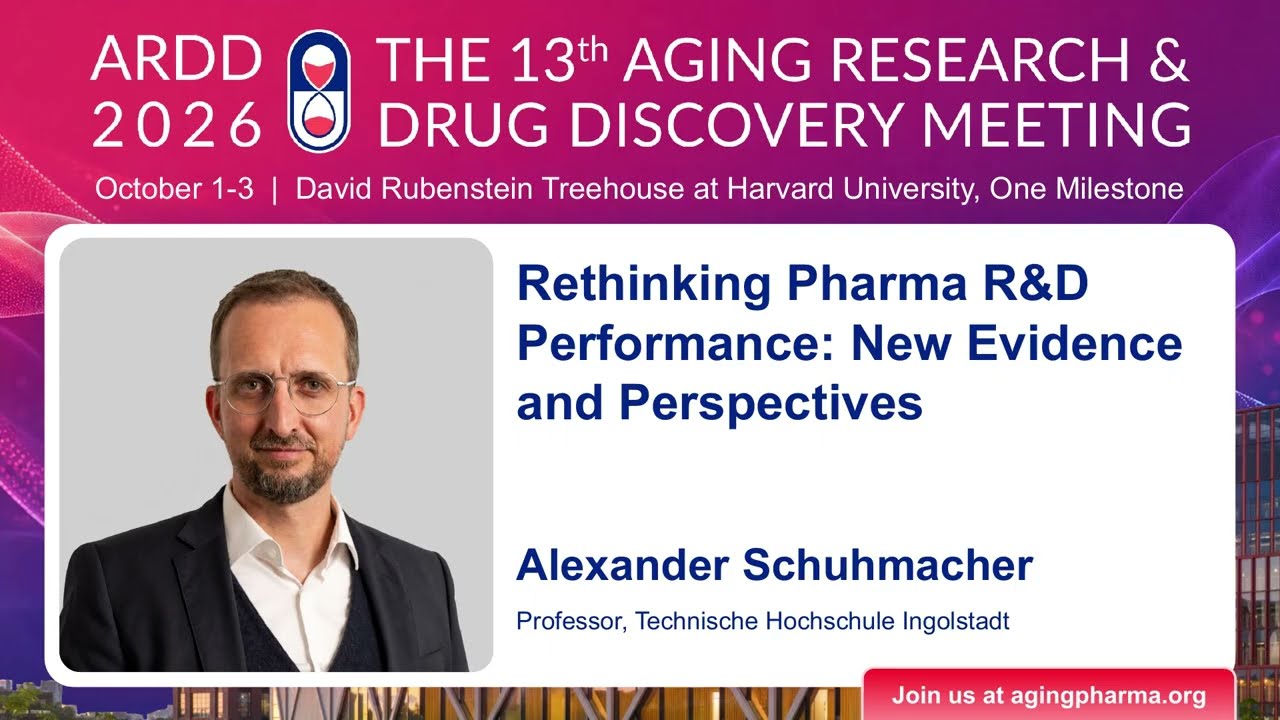
Alexander Schuhmacher at ARDD2026: Rethinking Pharma R&D Performance
Keywords
Summary
150 words
Critical Evaluation
Value of the Information & Strength of the Argument
The presentation provides valuable insights from original research conducted by the Competence Center for Pharma Innovation. The argumentation is structured and evidence-based, using data from large panel analyses over many years. The distinction between R&D efficiency and effectiveness is a useful framework. The finding that one-third of approved drugs are R&D unprofitable is striking and well-supported. The speaker clearly explains the methodological approach and the reasoning behind the conclusions. However, some claims could benefit from more detailed explanation and direct references to specific studies.
Scientific Rigor, Source Quality, Title Accuracy
The speaker is a credible academic, and the research appears rigorous with a clear methodology. However, in the transcript, he does not cite specific sources by name or provide direct references; the description contains only organizational links. The title matches the content well. No comments are provided, so audience reception cannot be assessed. The scientific rigor is high, but the lack of inline citations in the talk limits immediate source verification.
170 words
Title / Content Match
The title accurately reflects the content: a presentation on rethinking R&D performance with new evidence and perspectives.
Quality & Reliability
8/10
The presenter is an academic from the Competence Center for Pharma Innovation at the University of St. Gallen, with several peer-reviewed studies referenced. The talk summarizes published research findings, though specific citations are not given in the transcript. The reasoning is transparent and based on data from large panel analyses.
Key Moments
Markers derived by PSI from the transcript: the creator did not define chapters.
- Introduction and context of R&D productivity in pharma
- Historical background and four research streams
- Presentation of the Competence Center and research framework
- Key findings on success rates and R&D profitability
- Analysis of external vs. internal drug discovery and business model evolution
- Lifecycle profitability analysis and the one-third unprofitable finding
- Strategic tradeoffs between efficiency and effectiveness, and take-home messages
- Q&A session on future pharma models
Cited Sources
- Aging Pharma (ARDD website) — Official website of the conference organizer, mentioned in description
- ARDD LinkedIn page — LinkedIn presence of the conference, mentioned in description
Concurring Sources
- Scannell et al., 2012, 'Diagnosing the decline in pharmaceutical R&D efficiency' — Seminal paper documenting the decline in R&D efficiency, align with the presenter's concerns.
Dissenting Sources
- Criticism of R&D productivity metrics — Some researchers argue that simplistic input-output metrics underestimate the long-term value of drug portfolios, which might challenge the focus on immediate profitability.
Contribution & Novelties
The talk synthesizes recent research from the Competence Center for Pharma Innovation, offering a novel integrative perspective on pharma R&D performance. It highlights the underappreciated issue of R&D unprofitability among approved drugs and the strategic tradeoff between efficiency and effectiveness. The distinction between asset-centric and portfolio-centric strategies provides a useful framework for understanding company heterogeneous performance.
Pour aller plus loin :
- R&D productivity crisis — Context on the cost and productivity challenges in drug discovery.
- Blockbuster drug — Definition and significance in pharmaceutical business models.
- Absorptive capacity — Concept crucial for integrating external innovation, as discussed in the talk.
99 words
Radar Profile
The radar profile shows high scores in quantity, quality, and reliability, indicating a data-rich and credible presentation. The technical level is moderately high, suggesting content accessible to a specialized audience but not overly technical.