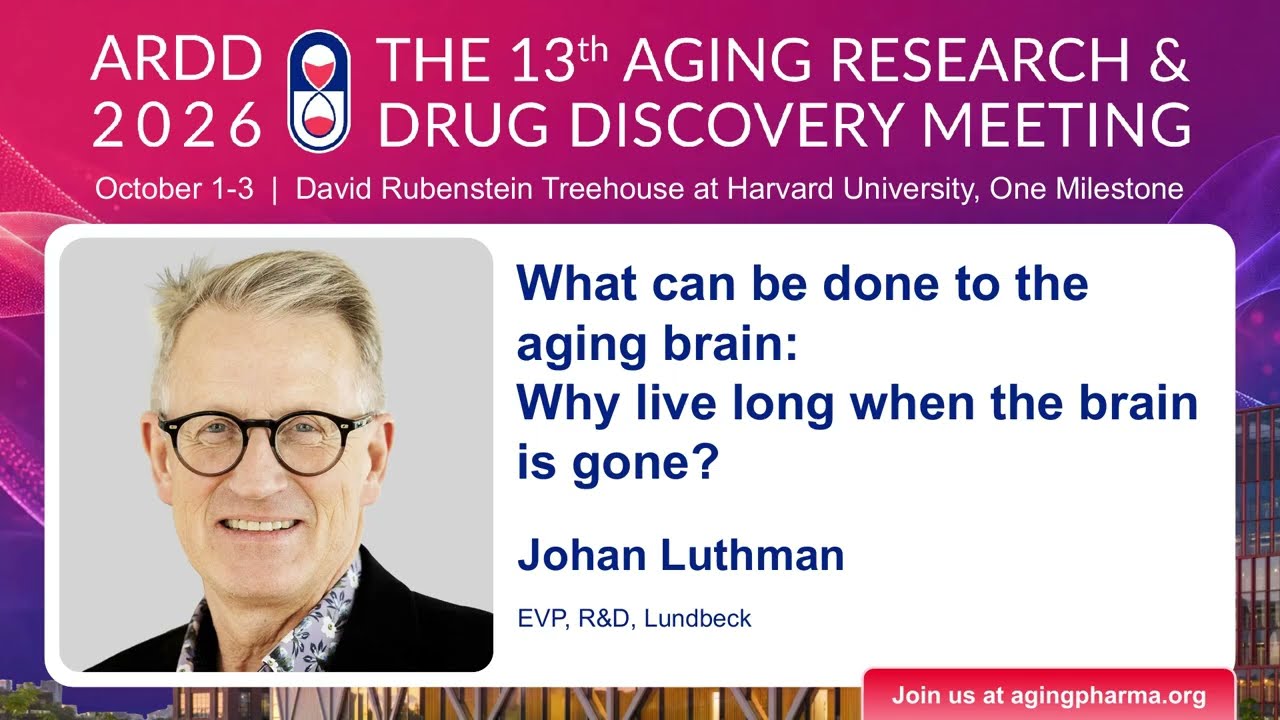
Johan Luthman at ARDD2026: What can be done to the aging brain
Keywords
Summary
156 words
Critical Evaluation
Value of the Information & Strength of the Argument
The value of the information is high due to the speaker’s direct industry experience. He provides specific data on drug efficacy and trial designs, and honestly acknowledges limitations, such as the inconclusive incretin trials and the lack of neuroprotective drugs. His argumentation is coherent: he systematically moves from normal aging to disease and to potential interventions, and he stresses the need for prevention and better biomarkers. However, his perspective is shaped by his affiliations, which he partially discloses, and some claims are presented without full statistical context.
Scientific Rigor, Source Quality, Title Accuracy
The talk demonstrates scientific rigor by referencing large cohort studies (e.g., ADNI), naming specific drugs and trials, and discussing regulatory challenges. He does not overclaim, noting that amyloid antibodies only slow decline and that biomarkers for other proteinopathies are lacking. The title is accurate. No comments were provided for analysis; therefore, no audience trends are discussed.
158 words
Title / Content Match
The title accurately reflects the content, discussing interventions, unmet needs, and future directions for the aging brain.
Quality & Reliability
7/10
The speaker is a recognized industry expert with direct involvement in drug development programs, providing practical insights and naming specific trials and biomarkers. However, potential conflicts of interest and the absence of full statistical details in the talk moderate the reliability score.
Key Moments
Markers derived by PSI from the transcript: the creator did not define chapters.
- Introduction and personal disclosure
- Normal brain aging: volume loss, microbleeds, and MRI changes
- Frail brain concept and dementia risk statistics
- Stroke, neuroplasticity, and recovery challenges
- Treatment options: symptomatic vs disease-modifying vs restorative
- Amyloid antibodies: efficacy, brainwash effect, and limitations
- Blood biomarkers and their role in diagnosis and screening
- Other proteinopathies: tau, TDP-43, and the MSA program targeting alpha-synuclein
- Bayesian adaptive trial design and MSA phase 3 study
- Future directions: cell therapy, brain-computer interfaces, and Allen Institute mapping
Cited Sources
- Aging Research and Drug Discovery Meeting — Official conference website
- ARDD LinkedIn Page — Company page for updates
Contribution & Novelties
The talk provides an industry insider’s view on the current state and future of treating the aging brain, focusing on the practical challenges of drug development, the importance of biomarkers, and the potential of Bayesian adaptive trials to accelerate research. The speaker shares specific experiences from amyloid antibody programs and a novel MSA trial, offering a unique perspective not commonly found in academic presentations.
Pour aller plus loin :
- Glymphatic system — Relevant to the discussion on sleep and brain clearance.
- Alzheimer’s disease — Overview of the disease and its pathology.
- Adaptive design (medicine) — Explains Bayesian adaptive trial methods mentioned in the talk.
- Alpha-synuclein — Protein implicated in Parkinson’s and MSA, central to the discussed program.
117 words
Radar Profile
The radar profile shows a high technical level and strong information quantity, but moderate global reliability due to potential bias. The quality is good but not exceptional, leading to a balanced overall score of 4.