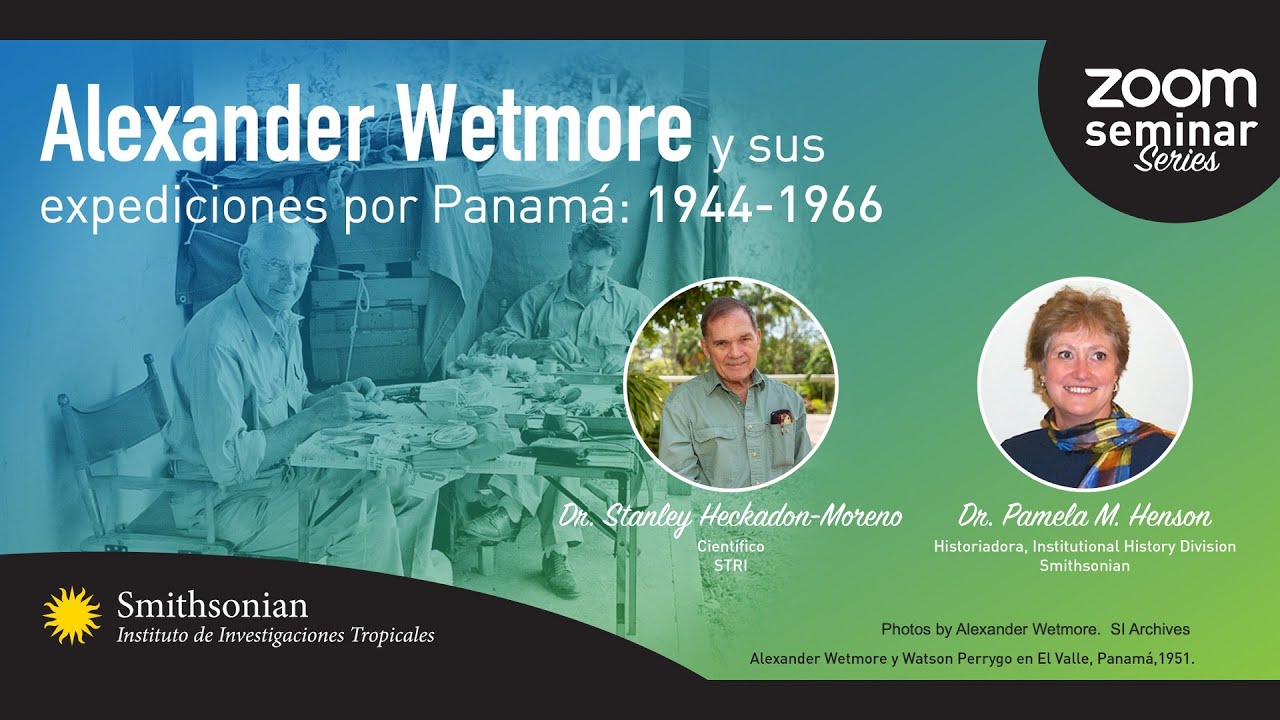
Zoom Seminar Series: Alexander Wetmore and his Panama Expeditions by Dr. Stanley Heckadon
Title history
- Zoom Seminar Series: Alexander Wetmore and his Panama Expeditions by Dr. Stanley Heckadon — observed on 20261025-2005 UTC (YouTube)
Keywords
Summary
187 words
Critical Evaluation
Value of the Information & Strength of the Argument
The value of the information lies in its unique blend of ornithological history and cultural anthropology, offering a comprehensive view of Wetmore’s work that extends beyond bird taxonomy. Heckadon-Moreno’s argumentation is solid, grounded in archival evidence from the Smithsonian, personal interviews with surviving assistants, and extensive correspondence. He convincingly demonstrates Wetmore’s dual role as a scientist and an ethnographer, making the case that his field observations of Panamanian society are as valuable as his bird collections. The speaker’s background in anthropology and sociology enriches the interpretation, though some claims (e.g., the idea that Wetmore was ‘reincarnated’ as an anthropologist) are anecdotal rather than evidence-based. Overall, the argument is well-structured, but the narrative sometimes lacks critical sourcing for specific claims.
Scientific Rigor, Source Quality, Title Accuracy
The talk relies heavily on primary sources from the Smithsonian Archives, including 25 boxes of photograph albums, correspondence, and field notes. Heckadon-Moreno also used oral histories, such as interviews with Wetmore’s field assistant Watson Perrigo and the Hartman brothers. He explicitly mentions consulting records from the U.S. Army Air Force and the National Geographic, which published some of the photographs. The speaker takes care to credit these sources, though without formal citations within the talk. The title is fully appropriate, as the content exactly matches the subject. No contradictions with established scholarship were noted, but the talk is presented more as a personal exploration than a systematic historical critique.
243 words
Title / Content Match
The title accurately reflects the content, which focuses on Alexander Wetmore's 22 expeditions to Panama and their scientific and sociocultural context.
Quality & Reliability
8/10
The talk is delivered by an expert scientist with extensive archival research, but it remains a seminar presentation based on personal interpretation rather than peer-reviewed publication.
Key Moments
Markers derived by PSI from the transcript: the creator did not define chapters.
- Introduction by Dr. Pamela Henson and presentation of speaker Stanley Heckadon-Moreno
- Wetmore's early career, connection to Panama, and his interest in the Pearl Islands
- Expeditions to the Darién, encounters with indigenous peoples, and the role of the U.S. Army Air Force
- Discovery of archaeological sites in the Azuero Peninsula and collaboration with Smithsonian archaeologists
- Wetmore's use of a jeep, his observations of local customs, and his friendship with Dr. Alejandro Méndez Pereira
- Wetmore's role in saving the Barro Colorado Island station and his legacy for tropical research
Cited Sources
- The Birds of Panama (four volumes) — The monumental work by Alexander Wetmore, based on his expeditions, which Heckadon-Moreno discusses extensively.
- Alexander Wetmore y las Aves de Panamá (book) — Heckadon-Moreno's upcoming Spanish-language book about Wetmore's expeditions and Panama's birds.
- Smithsonian Institution Archives — Where Wetmore's papers and photo albums are held; the primary archival source used by the speaker.
- National Geographic — Mentioned as publishing a photograph of the archaeological expedition in Azuero.
Contribution & Novelties
The talk brings a novel sociocultural perspective to Wetmore’s scientific expeditions, emphasizing his documentation of Panamanian rural life, indigenous customs, and architectural history. Heckadon-Moreno’s use of Wetmore’s photographs and letters to reconstruct the country’s past is an original contribution, as is his effort to locate and honor Wetmore’s Panamanian field assistants. The presentation also highlights Wetmore’s institutional role in the creation of the modern STRI, which is not always emphasized in ornithological histories.
Pour aller plus loin :
- Alexander Wetmore — Wikipedia article summarizing his life and career as ornithologist and Smithsonian Secretary.
- Smithsonian Tropical Research Institute — Overview of the institute Wetmore helped preserve, and its ongoing research in Panama.
- Barro Colorado Island — Details on the research station founded in 1923, central to Wetmore’s legacy and the focus of STRI’s centennial.
133 words
Radar Profile
The scores suggest a well-balanced profile with high information quantity and quality, moderate technical depth, and strong reliability. The lower technical score reflects the historical and narrative nature of the content, while the overall reliability is strengthened by the use of archival sources.