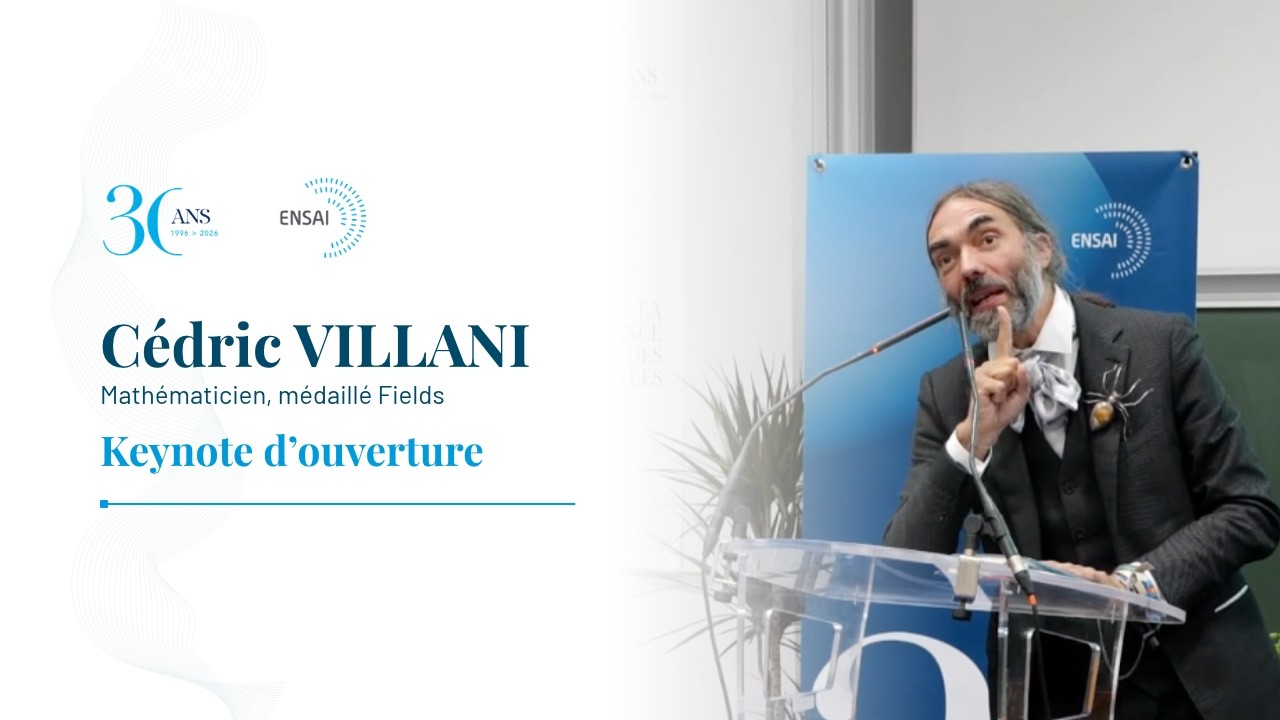
Cédric Villani - Keynote sur les Intelligences - 30 ans de l'ENSAI
Title history
- Cédric Villani - Keynote sur les Intelligences - 30 ans de l'ENSAI — observed on 20261110-0712 UTC (YouTube)
Keywords
Summary
184 words
Critical Evaluation
Value of the Information & Strength of the Argument
The talk provides valuable insight from a renowned mathematician, blending historical context with modern developments. Villani’s argumentation is persuasive, using concrete examples (e.g., Bernoulli, Netflix, Navier-Stokes) to illustrate his points. He effectively demonstrates the resurgence of statistics and its critical role in AI. The discussion of societal influences on AI science is coherent and well-argued, though some assertions about AI’s mathematical achievements are presented without citations or verification, relying on anecdotal evidence.
Scientific Rigor, Source Quality, Title Accuracy
Villani’s scientific rigor is high, given his credentials and the careful historical narrative. However, his remarks about AI accomplishments (e.g., the Navier-Stokes result) are stated as facts without primary sources, which could be questioned. The title is appropriate, and the content aligns with the theme of intelligences. No comments were provided for analysis.
140 words
Title / Content Match
The title accurately reflects the content: Villani delivers a keynote on artificial and human intelligence, with a strong focus on statistics and mathematics.
Quality & Reliability
7/10
Cédric Villani is a Fields medalist and highly credible mathematician. The talk is a keynote based on personal experience and observations rather than new research, but the insights are well-reasoned and grounded in historical facts. Some claims (e.g., AI proving theorems) are presented as certainties without detailed evidence, warranting a slight reduction in score.
Key Moments
Markers derived by PSI from the transcript: the creator did not define chapters.
- Villani begins his keynote, thanking the audience and introducing the theme of intelligence.
- First point: statistics's comeback and its undervaluation in the past.
- Bernoulli's early statistical study on vaccination as an example.
- Introduction of matrix completion and the Netflix problem, with Emmanuel Candès' work.
- Application to medical imaging, reducing scan time by almost a factor of 10.
- Second point: AI as a societal and political phenomenon, with large sums of money and hype.
- Discussion of the 2018 report to the French government and the scale of AI investments.
- AI's role in mathematics, including a 2026 Navier-Stokes refutation, and the contrast with Perelman's work.
Cited Sources
- ENSAI LinkedIn — Official ENSAI school page from the video description.
Concurring Sources
- Matrix completion — Supports the discussion of matrix completion as a statistical and mathematical method.
- Navier–Stokes existence and smoothness — Relates to the 2026 AI result mentioned by Villani.
Contribution & Novelties
The keynote offers a unique perspective from a prominent mathematician on the intersection of statistics, AI, and society. It contributes a historical narrative strengthening the importance of statistical methods in modern AI, and highlights the unpredictability of AI’s capabilities. Villani’s personal anecdotes (e.g., the 1994 warning about democratic issues) add originality.
Pour aller plus loin :
- Matrix completion — Relevant to the Netflix problem and compressed sensing discussed in the talk.
- Navier–Stokes existence and smoothness — One of the Millennium Prize Problems referenced in the context of AI’s 2026 result.
- Fields Medal — To understand the distinction Villani holds and the context of mathematical recognition.
105 words
Radar Profile
The radar profile shows a balanced performance across quantity and quality of information, with a slightly lower technical level reflecting the accessible tone of the talk. Reliability is moderate, consistent with a keynote based on personal experience rather than peer-reviewed research.