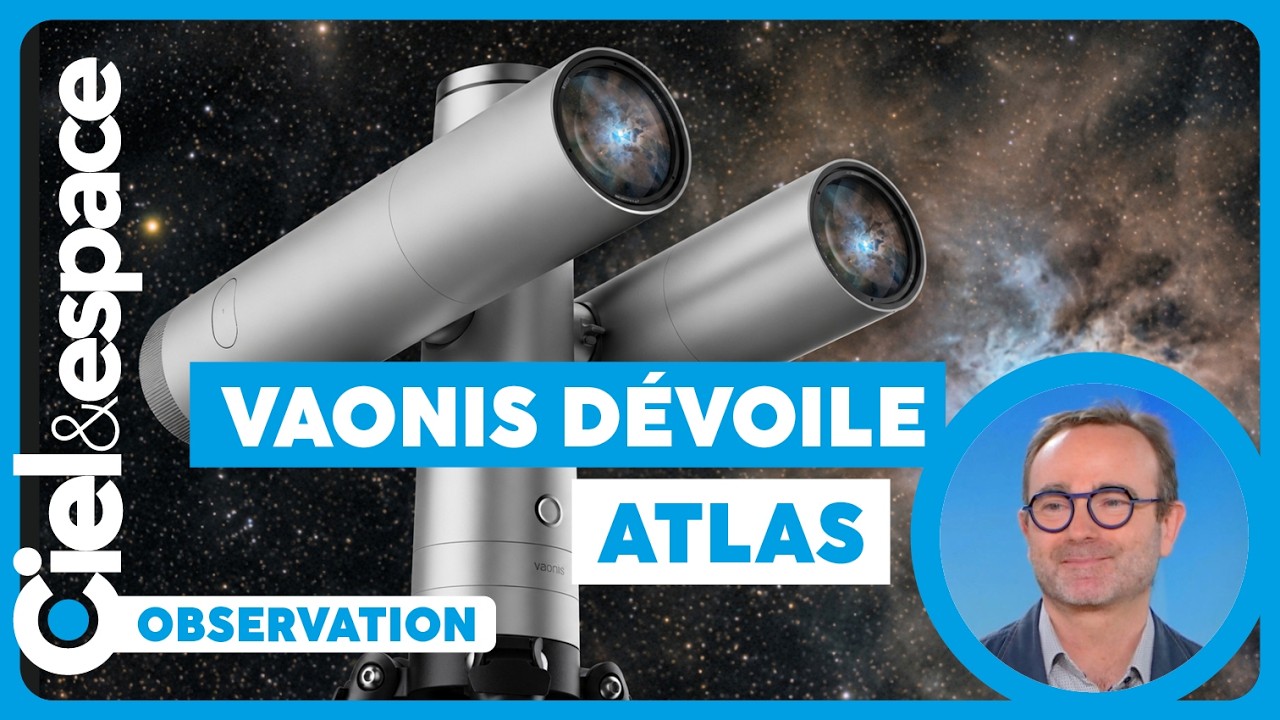
ATLAS : smart télescope du Futur ?
ATLAS: The smart telescope of the future?
Keywords
Summary
163 words
Critical Evaluation
Value of the Information & Strength of the Argument
The video offers valuable information for amateur astronomers by providing early details on the Atlas and insights from industry leaders. The interviews are well-conducted and bring depth to the discussion, particularly regarding Vaonis’ strategy and the market evolution. However, the argumentation is largely from the manufacturers’ perspective, with limited critical analysis of potential drawbacks such as the absence of a cooled sensor or the high price. Some claims about performance and competition are presented without direct evidence, though the presenter does express personal opinions on value, making the overall assessment balanced yet not fully objective.
Scientific Rigor, Source Quality, Title Accuracy
The scientific rigor is moderate: while the video references actual products and interviews, it relies on manufacturer statements without independent verification. The title accurately matches the content, focusing on the Atlas and its market context. The description includes two external links (SvBony product page and magazine subscription), which are used for product purchase and promotion, not for sourcing scientific evidence. No contradictory sources are presented, and the overall approach is journalistic rather than strictly scientific. The video does mention a test published in the magazine, adding some credibility, but the lack of peer-reviewed references limits its scientific depth.
208 words
Title / Content Match
The title accurately reflects the content, as the video focuses on the Vaonis Atlas, a new smart telescope, and discusses its potential and market position.
Quality & Reliability
7/10
The video provides detailed product information and exclusive interviews with key industry figures, but is largely based on manufacturers' claims and lacks independent verification. The journalistic style is professional, yet some promotional aspects and the subjective tone on aesthetics slightly reduce overall objectivity.
Key Moments
Markers derived by PSI from the transcript: the creator did not define chapters.
- Introduction and overview of the video's topics, including the Atlas reveal and interviews.
- Brief test report on the SvBony Maksutov 127 telescope, available in the magazine.
- Detailed presentation of the Vaonis Atlas: design, features, modularity, and price.
- Interview with Cyril Dupuy, founder of Vaonis, discussing the Atlas philosophy and future modules.
- Interview with Sam Weng, founder of ZWO, on market competition and the evolution of smart telescopes.
- Preview of the SkyWatcher Orbis 60 EDX, another new product in the smart telescope market.
Cited Sources
- SvBony MK127 Maksutov-Cassegrain Telescope — Product page for the telescope tested briefly in the video, with a promotional discount code.
- Ciel & Espace Abonnement — Subscription page for the magazine, mentioned for supporting the channel and accessing the full test.
Contribution & Novelties
The video provides exclusive, early information on the Vaonis Atlas, a modular smart telescope, with in-depth interviews with the founders of Vaonis and ZWO. It highlights the trend toward modularity and immersive experiences in astrophotography, and discusses market dynamics between premium Western brands and more affordable Asian competitors. The emphasis on dual-module functionality and future modules (planetary and monochrome) offers new perspectives for enthusiasts.
Pour aller plus loin :
- Amateur astronomy — Overview of the hobby and its practices, relevant to the target audience.
- Astrophotography — Background on the techniques and evolution of astrophotography, including smart telescopes.
- Telescope — General information on optical instruments, useful for understanding the modular concepts discussed.
111 words
Radar Profile
The profile shows high scores in information quantity and quality, indicating a rich and informative video. Technical level is moderate, suitable for a general audience interested in astronomy. The global reliability is good but not perfect, due to reliance on manufacturer claims.