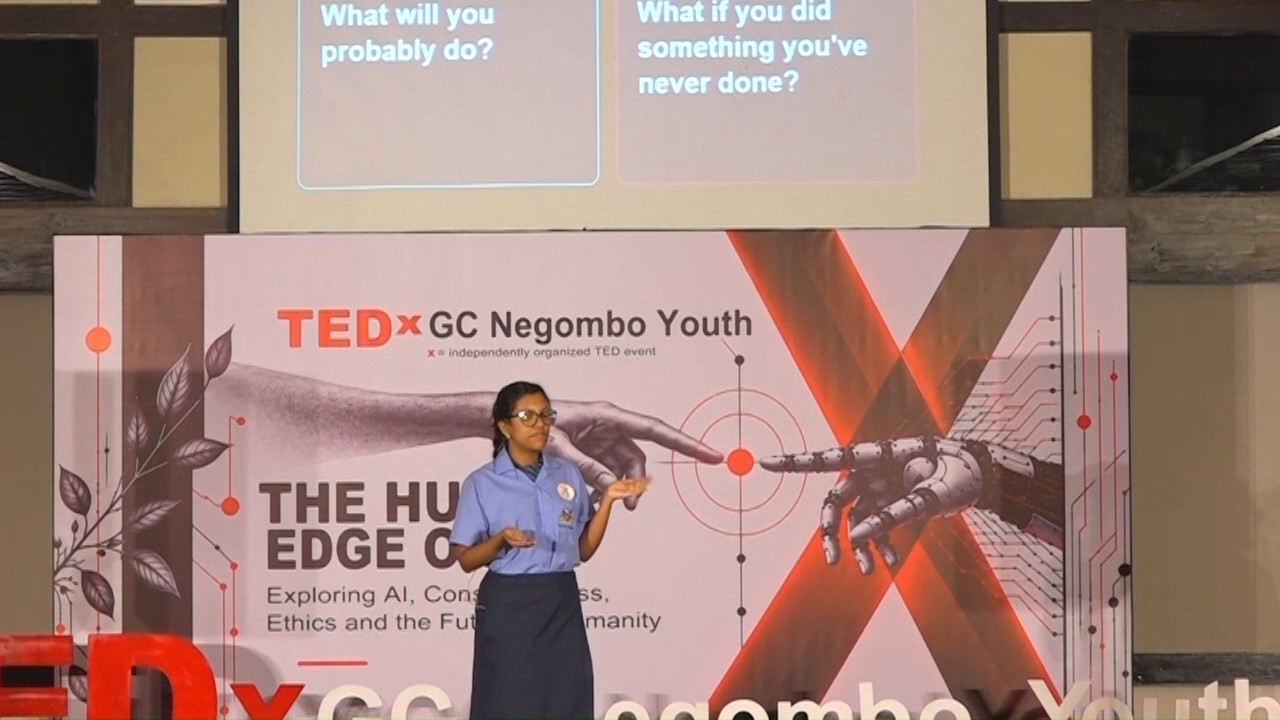
The death of the first draft | Oneli Fernando | TEDxGC Negombo Youth
Title history
- The death of the first draft | Oneli Fernando | TEDxGC Negombo Youth — observed on 20261101-0403 UTC (YouTube)
Keywords
Summary
185 words
Critical Evaluation
Value of the Information & Strength of the Argument
The talk offers a thoughtful and emotionally engaging reflection on creativity and AI, grounded in personal experience rather than empirical evidence. The argument is coherent: it moves from a poignant anecdote to a broader philosophical claim about the importance of process over product. Fernando effectively illustrates that the imperfections in a first draft can carry intrinsic human value, as shown by her childhood letter and the child’s drawing metaphor. She raises valid concerns about the potential devaluation of the creative struggle in an AI-assisted world, and her point that ‘some obstacles are how we learn’ is compelling. However, the reasoning is largely anecdotal and lacks rigorous logical development or alternative perspectives. The argument is persuasive on an emotional level but does not deeply engage with counterarguments about AI’s benefits for creativity or the potential for human-AI collaboration. The conclusion, while inspiring, is more rhetorical than analytical.
Scientific Rigor, Source Quality, Title Accuracy
The talk is a personal narrative with no external citations or references, aside from the generic TEDx link in the description. It does not demonstrate scientific rigor or systematic research, but rather offers an individual perspective on a contemporary issue. The title ‘The death of the first draft’ is metaphorical and adequately represents the central theme, though it could be seen as overly dramatic. The content aligns well with the title, as the speaker discusses how the value of the first draft is being neglected in favor of polished AI-generated outputs. There are no comments provided to analyze public reception, so no trends can be assessed.
267 words
Title / Content Match
The title accurately captures the talk's central metaphor about the risk of losing the imperfect creative process in an AI-driven world.
Quality & Reliability
5/10
Personal reflection with no cited sources; provides anecdotal evidence and thought-provoking arguments rather than empirical data.
Key Moments
Markers derived by PSI from the transcript: the creator did not define chapters.
- Introduction of the childhood letter and its significance.
- Discussion on the purpose of first drafts and the embarrassment often attached to them.
- Experiment with AI improving the letter; the loss of the imperfect but meaningful part.
- Comparison between machine-produced art and human experience, illustrated by a child's drawing.
- Concluding remarks on the importance of imagining and creating without needing to be perfect.
Cited Sources
- TEDx Program — Reference to the TEDx event format and the talk's official platform.
Contribution & Novelties
The talk contributes a personal and emotional perspective on the impact of AI on creativity, emphasizing the intrinsic value of the imperfect first draft as a stage of human development. Unlike technical analyses of AI capabilities, it focuses on the subjective experience of the creator and the potential loss of learning and growth that occurs when the process is bypassed. It also highlights the distinction between ‘creating something’ and ‘becoming better at creating something’, which is a nuanced point often overlooked in AI discussions.
Pour aller plus loin :
- Creativity (Wikipedia) — Provides an overview of creative processes and theories, relevant to the talk’s emphasis on imagination and struggle.
- Artificial intelligence (Wikipedia) — Contextualizes the capabilities and limitations of AI, useful for understanding the technological backdrop.
- Draft (document) (Wikipedia) — Explains the concept of drafts in writing, directly related to the talk’s central metaphor.
144 words
Radar Profile
The radar profile shows a moderate quantity of information with a slightly higher quality, indicating a thought-provoking but not information-dense presentation. Technical level is low, reflecting the accessible and non-technical nature of the talk. Reliability is the weakest dimension, consistent with the absence of cited sources and reliance on personal anecdote.