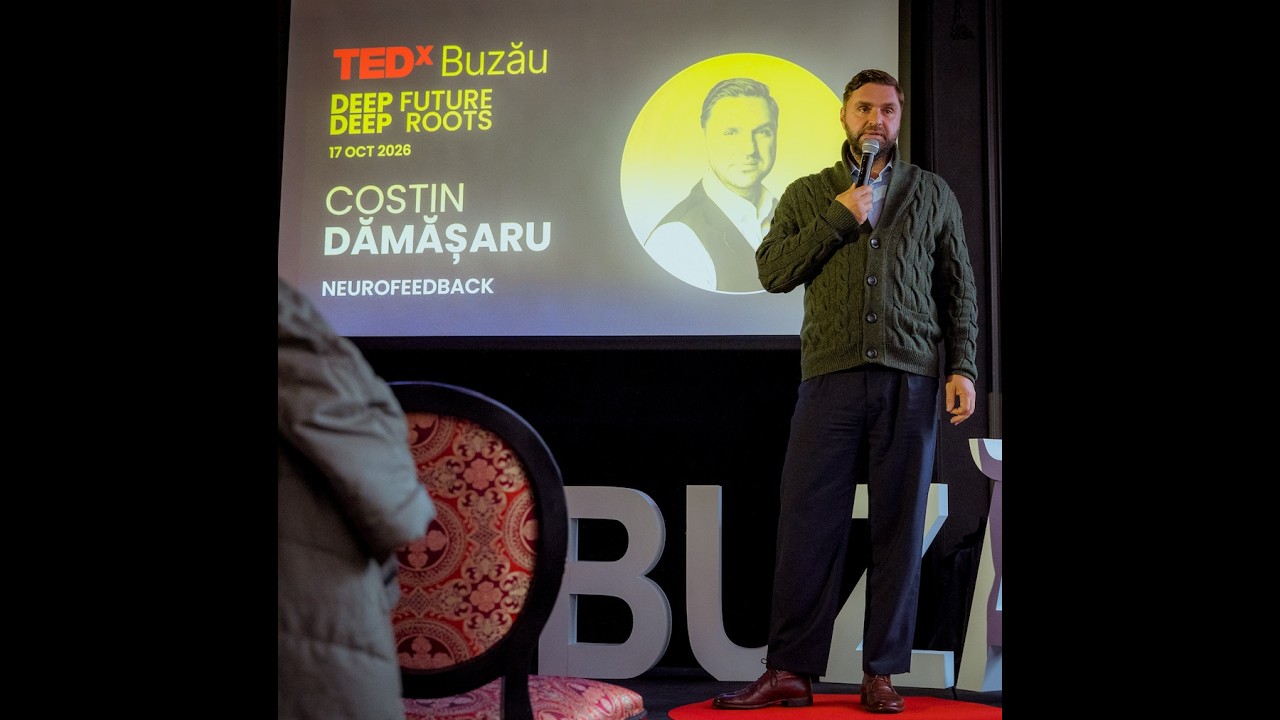
Dincolo de gânduri: creierul, depresia și puterea de a alege | Costin Dămășaru | TEDxBuzau
Beyond Thoughts: The Brain, Depression, and the Power of Choice | Costin Dămășaru | TEDxBuzau
Title history
- Dincolo de gânduri: creierul, depresia și puterea de a alege | Costin Dămășaru | TEDxBuzau — observed on 20261106-1652 UTC (YouTube)
Keywords
Summary
191 words
Critical Evaluation
Value of the Information & Strength of the Argument
The value of the information lies in the speaker’s candid personal testimony and his practical advice for managing panic attacks, which may be useful for laypeople. However, the argumentation is largely anecdotal and relies on oversimplified analogies (e.g., water and steam) that lack scientific precision. The claim that epigenetic information is transmitted for seven generations is a distortion of current scientific consensus, as such transmission in humans is not empirically proven to that extent. The speaker also makes sweeping assertions without presenting empirical data from his claimed 18,000 cases. The reasoning is intuitive but not methodologically rigorous, and the leap from neurobiology to philosophical interpretations of ‘original sin’ is conceptually weak. Nevertheless, the talk effectively raises awareness about the brain’s protective mechanisms and the importance of self-agency in mental health.
Scientific Rigor, Source Quality, Title Accuracy
The talk cites several authors informally, including Yuval Noah Harari and Joseph Campbell, but does not provide specific references or data. The only external link in the description is the general TEDx page, which does not substantiate the scientific claims. The speaker mentions his own book and research projects at the Romanian Academy and Politehnica Bucharest, but no evidence or outcomes are provided. The title accurately reflects the core themes of the brain, depression, and the power to choose, even though the talk includes many digressions. Overall, the scientific rigor is low, with sources being more inspirational than verifiable, and the title-content alignment is acceptable.
250 words
Title / Content Match
The title promises a discussion on the brain, depression, and the power to choose; the talk covers these themes but wanders into various tangents, yet overall it stays relevant.
Quality & Reliability
4/10
The talk presents personal experiences and anecdotal evidence, with some references to scientific concepts, but lacks rigorous citations and overstates certain findings such as multi-generational epigenetic transmission.
Key Moments
Markers derived by PSI from the transcript: the creator did not define chapters.
- Introduction with the tree example to illustrate misconceptions about survival.
- Personal story of suicide attempt and the start of his mission.
- Explanation of the brain-mind system and its primary objective of survival.
- Discussion of trauma, cognitive dissonance, and the brain as a protective yet imprisoning system.
- Epigenetics and the idea of transgenerational trauma; reference to Joseph Campbell and Harari.
- Metaphor of water and steam to explain the mind as a function of the brain.
- Panic attack emergency kit: breathing, grounding through touch, and the mantra 'it is not permanent'.
Cited Sources
- TEDx Talks — The official TEDx platform where this talk is hosted.
- Sapiens: A Brief History of Humankind — Referenced in the talk as one of Yuval Noah Harari's influential books on human narratives.
- Joseph Campbell — Cited for his interpretations of mythology and the 'original sin' as transgenerational information.
Contribution & Novelties
The talk offers a personal framework for understanding the brain-mind relationship, emphasizing the brain’s survival priority and the role of narrative dissonance in mental dysfunction. The practical emergency kit for panic attacks (breathing, grounding, and a mantra) is a concrete takeaway. However, the scientific novelty is limited, as these ideas are common in cognitive-behavioral approaches and neuroscience popularization.
Pour aller plus loin :
- Epigenetics — The study of heritable changes in gene expression; relevant to the speaker’s claims about transgenerational trauma.
- Neurofeedback — A technique mentioned indirectly through qEEG-guided neurofeedback; useful for understanding brain training.
- Mind–body problem — Philosophical debate about the relationship between consciousness and the brain, directly related to the talk’s theme.
- Panic attack — Clinical context for the emergency kit advice.
124 words
Radar Profile
The radar profile shows moderate scores in quantity and quality of information, with lower technical level and reliability. This reflects a talk that is engaging and provides practical advice but lacks in-depth scientific grounding and precise citations.