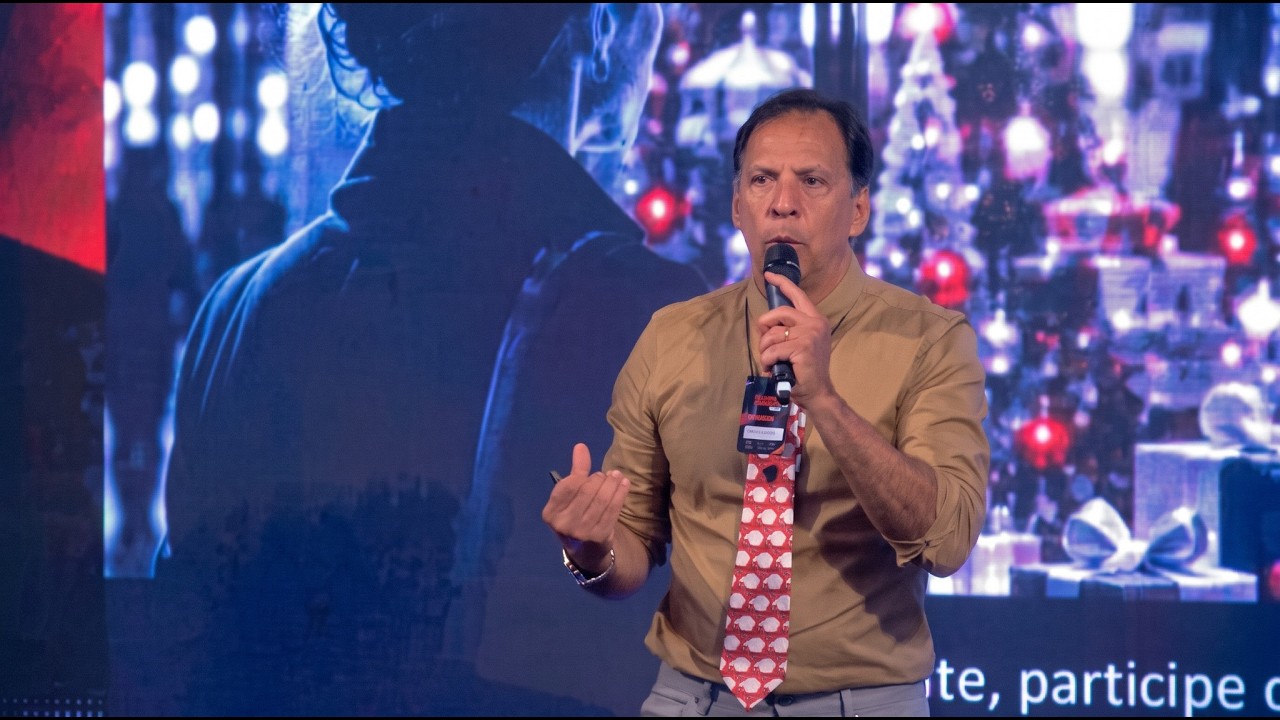
Você escolhe ou escolhem por você? | Roberto Mendes | TEDxPraça Getúlio Vargas
Do You Choose or Are You Being Chosen For? | Roberto Mendes | TEDxPraça Getúlio Vargas
Title history
- Você escolhe ou escolhem por você? | Roberto Mendes | TEDxPraça Getúlio Vargas — observed on 20261030-1708 UTC (YouTube)
Keywords
Summary
145 words
Critical Evaluation
Value of the Information & Strength of the Argument
The value of this talk lies in its accessible and thought-provoking exploration of how marketing and social norms shape identity and choice. Mendes builds his argument logically, moving from concrete examples (choosing a car) to abstract concepts (self-definition) and grounding it in philosophical references like Baudrillard and the Ship of Theseus. The argumentation is persuasive due to its relatable anecdotes and rhetorical questions, though it lacks empirical support and relies heavily on personal insight. The concept of ‘consumo da incompletude’ is original and offers a fresh lens on consumer behavior, but its claims are not rigorously tested. The talk effectively raises awareness but does not provide a systematic framework for resistance.
Scientific Rigor, Source Quality, Title Accuracy
The talk demonstrates moderate scientific rigor: it references established thinkers (Baudrillard) and a classic paradox (Ship of Theseus) but does not cite specific studies or data. The quality of sources is adequate for an opinion piece, yet the lack of verification weakens the argument. The title is highly accurate, matching the talk’s central question. No discernible discrepancy exists between the title and content. The description provides only a general TEDx link, which is not a direct source for the content. Overall, the talk is more a reflective essay than a scholarly exposition, but it remains intellectually honest in its open questions.
227 words
Title / Content Match
The title perfectly captures the central question of the talk: whether our choices are truly ours or externally influenced.
Quality & Reliability
6/10
The talk presents a coherent reflection on consumerism and identity, referencing Baudrillard and the Ship of Theseus, but lacks empirical evidence and detailed citations. The reasoning is engaging but based on personal insight and anecdotal examples rather than rigorous scientific data.
Key Moments
Markers derived by PSI from the transcript: the creator did not define chapters.
- Introduction: the paradox of choosing a gift and the silent architecture of consumption.
- Explores the concept of buying belonging and identity through products.
- Introduces 'consumo da incompletude' and how marketing exploits our gaps.
- Discusses Jean Baudrillard's theory on Santa Claus and advertising.
- Describes the car commercial example and why we accept the illusion.
- Introduces the Ship of Theseus paradox and the need to change our 'planks'.
Cited Sources
- TEDx official page — Link provided by the speaker to explain the TEDx event format.
Concurring Sources
- Jean Baudrillard - Wikipedia — Background on the philosopher and his analysis of consumer society.
- Ship of Theseus - Wikipedia — Explanation of the paradox as used by the speaker to prompt self-reflection.
Contribution & Novelties
The talk offers a novel conceptualization of consumer behavior through the term ‘consumo da incompletude’ (consumption of incompleteness), framing purchases as attempts to fill psychological gaps. It also synthesizes existing ideas (Baudrillard, Ship of Theseus) into an accessible and relatable narrative for a general audience. The questioning of personal responsibility in perpetuating consumerist patterns is provocative and encourages self-examination.
Pour aller plus loin:
- Jean Baudrillard — His theory of consumer society underpins the talk’s ideas on how advertising creates desire.
- Ship of Theseus — The classic paradox used to question identity and change.
- Consumerism — The broader context of the talk’s critique of consumption habits.
105 words
Radar Profile
The radar profile shows relatively balanced scores across all dimensions, with quantitative and qualitative information slightly ahead of technical level and global reliability. This indicates a talk that is informative and thought-provoking but lacks deep empirical grounding and specialized depth, fitting an opinion-based presentation for a general audience.