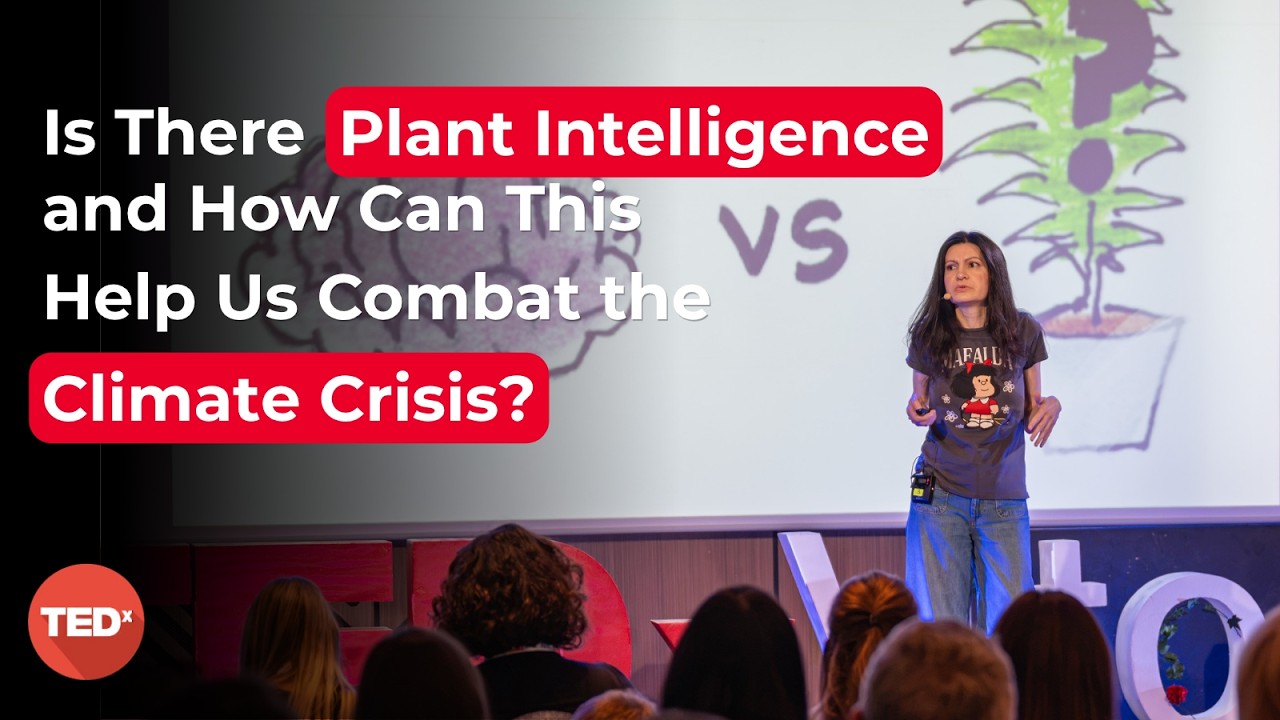
Интелигентни ли са растенията? | Galya Petrova | TEDxVitosha
Title history
- Интелигентни ли са растенията? | Galya Petrova | TEDxVitosha — observed on 20261104-2229 UTC (YouTube)
Keywords
Summary
164 words
Critical Evaluation
Value of the Information & Strength of the Argument
The talk provides engaging, accessible examples of plant behavior that illustrate the concept of plant intelligence. The speaker, a geneticist, presents the mycorrhizal network and chemical signaling as evidence of complex plant communication. The argument is structured logically, moving from general examples to specific case studies, culminating in a call to apply plant adaptations to agriculture. However, the argument relies heavily on anecdotal observations and popular science metaphors rather than rigorous experimental data. The claim that Venus flytraps ‘count’ is factually correct, and the acacia-giraffe example is well-documented. While the talk inspires curiosity, it lacks depth in explaining mechanisms and does not address counterarguments or debates within plant neurobiology. The value lies in raising awareness and framing plants as intelligent agents, but the argumentation is more persuasive than exhaustive.
Scientific Rigor, Source Quality, Title Accuracy
The talk is based on well-known scientific phenomena, but no specific studies or citations are given during the presentation. The speaker is a geneticist, which lends some credibility, but the content is presented in a popularized manner. The description mentions only a general TEDx link, and no detailed references are provided. The title accurately reflects the content, and the talk respects the TEDx format. The scientific rigor is moderate: examples like the mycorrhizal network and resurrection plant are widely recognized, yet the talk does not discuss nuances or alternative interpretations. There are no comments analyzed, so public reception cannot be assessed.
245 words
Title / Content Match
The title perfectly matches the content: the talk investigates the concept of plant intelligence with concrete examples and arguments.
Quality & Reliability
6/10
TEDx talk by a geneticist, content is plausible and supported by well-known examples, but no peer-reviewed sources cited in the talk itself; the argument is anecdotal and somewhat broad.
Key Moments
Markers derived by PSI from the transcript: the creator did not define chapters.
- Introduction: asking if plants feel pain, setting up the theme of plant intelligence.
- Presentation of the mycorrhizal network as the 'social network' of plants.
- Acacia tree example: chemical warnings and communication with neighbors against giraffes.
- Explanation of canopy 'crown shyness' as plant communication for space.
- Walking palms that move using roots, and Venus flytrap counting touches.
- Introduction of Haberlea rhodopensis as a resurrection plant and its potential for agriculture.
Cited Sources
- TEDx Talks — Link provided in the video description.
Concurring Sources
- Plant intelligence — General concept of plant intelligence corroborates the talk's premise.
- Mycorrhizal network — Provides scientific backing for the network described.
- Haberlea rhodopensis — Details on the resurrection plant's ecology and genetics.
Contribution & Novelties
This talk offers an accessible overview of plant intelligence, bringing together examples from different species to argue that plants exhibit adaptive behaviors akin to intelligence. Its original contribution is framing plant capabilities as a potential solution to climate change, specifically by studying genes from resurrection plants. While most examples are known, the talk integrates them into a coherent narrative that encourages a paradigm shift.
Pour aller plus loin :
- Plant intelligence on Wikipedia — Provides a broader scientific background and debates.
- Mycorrhizal network — Detailed information on the underground fungal communication web.
- Venus flytrap — Scientific details on the counting mechanism and triggering process.
- Haberlea rhodopensis — More about the resurrection plant and its unique drought tolerance.
117 words
Radar Profile
The profile shows balanced but moderate scores across all dimensions, with 'quantite_information' slightly lower due to the talk's brevity and lack of in-depth data. 'Qualite_information' and 'fiabilite_globale' are average, reflecting the popular-science nature. The talk is accessible but not technically deep, aligning with a public audience.