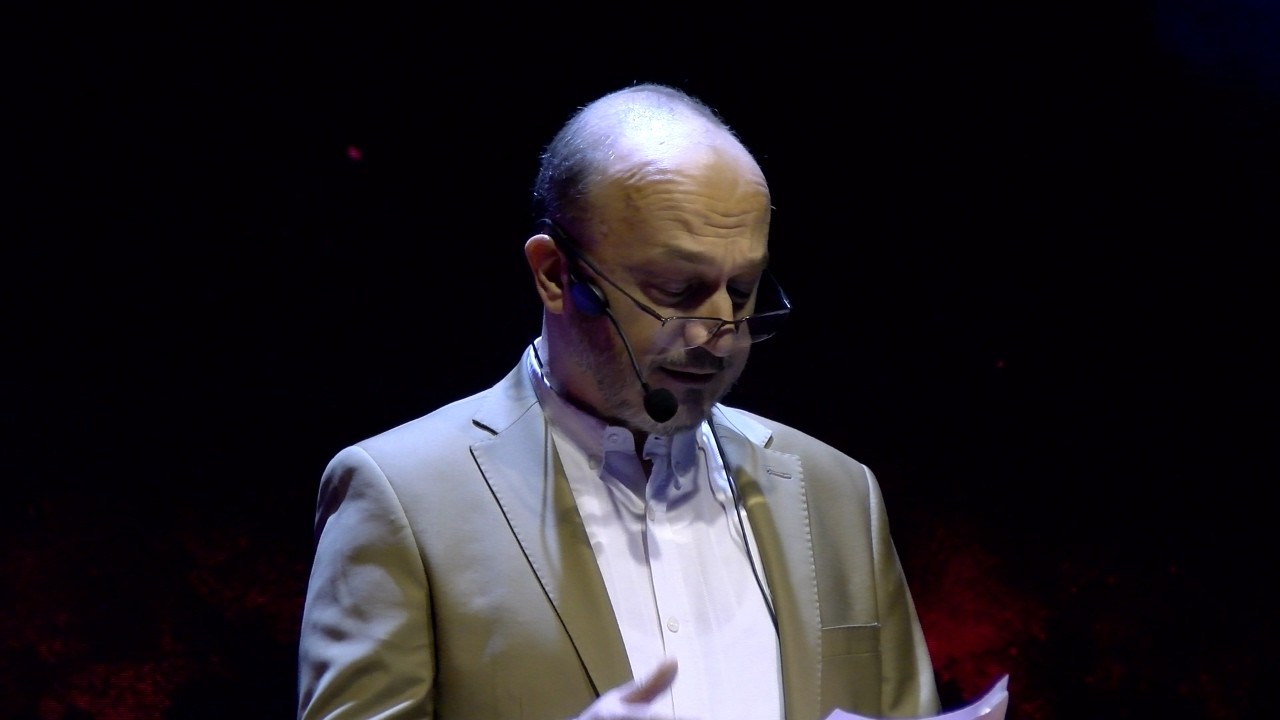
The Mind's Illusion or the Heart's Truth? | Murad Asiltürk | TEDxNecmettin Erbakan University
Keywords
Summary
157 words
Critical Evaluation
Value of the Information & Strength of the Argument
The talk provides a thought-provoking synthesis of neuroscience and spiritual philosophy, offering a valuable perspective on the limits of scientific reductionism. The argumentation is coherent and accessible, building from neurobiological facts to philosophical interpretations. However, some claims about the ‘heart’ as a decision-making center are metaphorical rather than empirically grounded, which may weaken the scientific rigor for a strictly materialist audience. The personal anecdotes and references to classical thinkers enrich the narrative but occasionally rely on anecdotal evidence rather than systematic analysis.
Scientific Rigor, Source Quality, Title Accuracy
The speaker is a neurosurgeon with medical expertise, lending credibility to the neuroscientific parts. However, he does not cite specific peer-reviewed studies, and the philosophical references are general. The title accurately captures the essence of the talk, but the content does not definitively resolve the mind-heart dilemma, leaving it as an open question. The description mentions TEDx and provides a standard link, but no additional scholarly sources are listed. Overall, the rigor is moderate; the talk is more exploratory and inspirational than strictly scientific.
181 words
Title / Content Match
The title directly addresses the core dichotomy between mind and heart, which is the central theme, though the content remains exploratory rather than conclusive.
Quality & Reliability
6/10
The talk offers a philosophical perspective on consciousness and the mind, referencing neuroscience, William James, Bergson, and Al-Ghazali. However, it lacks precise citations to specific studies and mixes speculative ideas with established science, making the reliability moderate.
Key Moments
Markers derived by PSI from the transcript: the creator did not define chapters.
- Opening anecdote: memory of childhood surfacing during a tense aneurysm surgery, questioning why such memories emerge under stress.
- Introduction to brain structure: 86 billion neurons, trillions of connections, and the limits of explaining subjective experience.
- Discussion of William James and Henri Bergson's filter/modem hypothesis of the brain, contrasting with pure materialistic views.
- Connection to Al-Ghazali's philosophy: the heart as a center of deep understanding and moral orientation, distinct from the biological organ.
- Exploration of the distinction between thought, consciousness, knowing, and feeling, emphasizing reflective awareness and intrapersonal intelligence.
- Final synthesis: brain vs. heart in decision-making, the role of humility (tevazu), and the call for a balanced view of human nature.
Cited Sources
- TEDx Talks — Organization of the TEDx event where this talk was given.
Contribution & Novelties
The talk’s originality lies in bridging modern neuroscience with classical Islamic philosophical concepts, particularly Al-Ghazali’s notion of the heart, to argue against a purely materialist view of consciousness. It provides a fresh perspective on the hard problem of consciousness by integrating spiritual and moral dimensions. The call for humility as an intellectual virtue is a meaningful contribution to debates on knowledge and ego.
Pour aller plus loin :
- Consciousness — Overview of the philosophical and scientific aspects of consciousness.
- William James — His theories on the stream of consciousness and the filter metaphor for the brain.
- Al-Ghazali — His philosophical and theological works, including the concept of the heart (qalb) in Islamic thought.
- Henri Bergson — His ideas on duration and the relationship between mind and matter.
127 words
Radar Profile
The radar profile shows a moderately high quantity of information and decent quality, but lower technical depth and reliability. The talk prioritizes philosophical reflection over empirical evidence, resulting in a balanced but not highly rigorous profile.