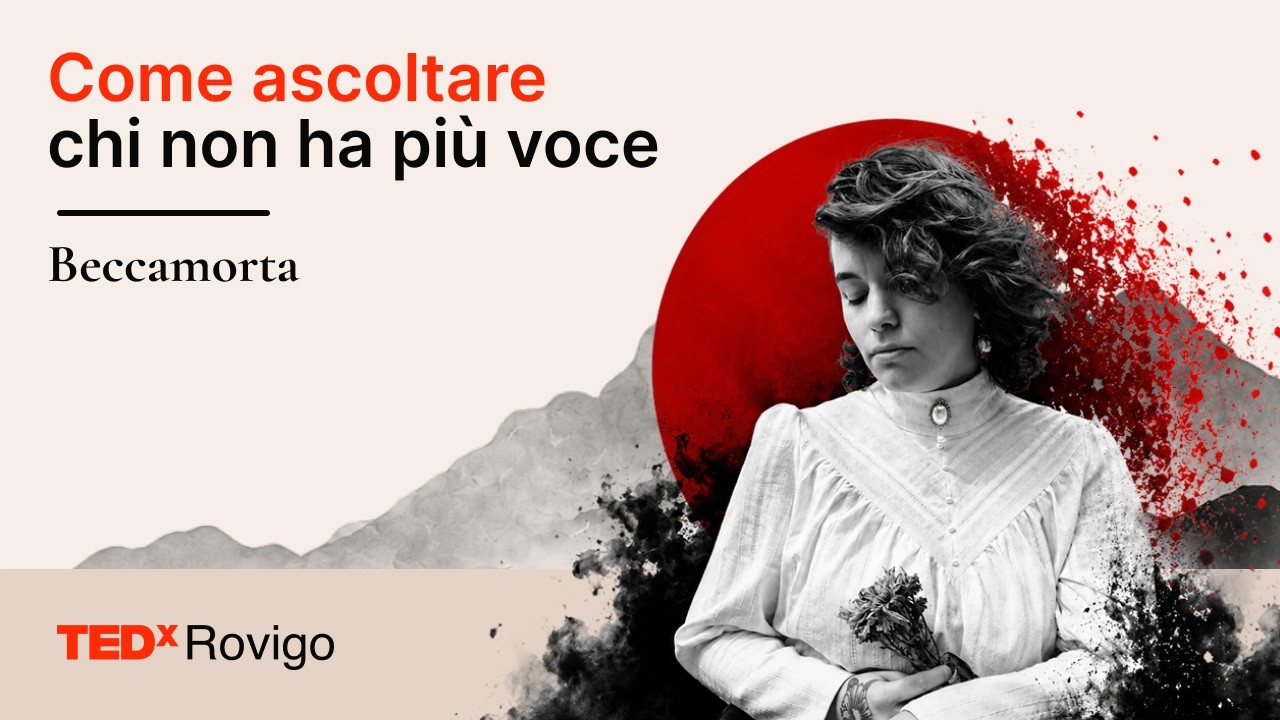
Come ascoltare chi non ha più voce | Veronica Zinnia - Beccamorta | TEDxRovigo
How to listen to those who no longer have a voice | Veronica Zinnia - Beccamorta | TEDxRovigo
Title history
- Come ascoltare chi non ha più voce | Veronica Zinnia - Beccamorta | TEDxRovigo — observed on 20261105-1655 UTC (YouTube)
Keywords
Summary
141 words
Critical Evaluation
Value of the Information & Strength of the Argument
The talk’s value lies in its emotional and humanistic approach to history, transforming abstract events into intimate, relatable narratives. Zinnia’s argument is compelling: that memory is a collective act and that we have a responsibility to preserve the stories of those who came before us. She effectively uses storytelling to illustrate her points, making the past tangible. However, the argumentation is primarily emotive rather than analytical; she does not engage with potential counterarguments or provide broader historical context. The strength of her case rests on personal conviction and vivid examples, which makes it persuasive but not scientifically rigorous.
Scientific Rigor, Source Quality, Title Accuracy
The talk is based on historical records and Zinnia’s own research, but no specific sources are cited during the talk. The description provides only the generic TEDx link. The title matches the content well, accurately conveying the talk’s focus on listening to the dead. The story of Anteo Zamboni is a known historical event, and Anna Vecchi’s case appears to be a lesser-known archival find. While the narratives are plausible, lacking explicit citations reduces their verifiability. The speaker’s credibility is built on her social media presence and personal mission rather than formal credentials in history. Overall, the talk is scientifically light but historically evocative.
217 words
Title / Content Match
The title accurately reflects the talk's theme of giving voice to the forgotten dead through attentive listening and storytelling.
Quality & Reliability
7/10
The talk is based on personal research and historical narratives, but lacks explicit citations or verifiable sources in the transcript. The stories are well-told and apparently grounded in archival work, yet the scientific rigor is limited by the anecdotal presentation.
Key Moments
Markers derived by PSI from the transcript: the creator did not define chapters.
- Zinnia introduces her relationship with cemeteries and the idea that they are places of new beginnings.
- She recounts childhood memories and the poem by Totò that sparked her interest.
- Transition to the story of Anteo Zamboni, a 15-year-old who attempted to assassinate Mussolini.
- Zinnia explains the concept of perpetual tombs and introduces the story of Anna Vecchi, a murder victim.
- She concludes with a vision of cemeteries as educational and communal spaces.
Cited Sources
- TEDx Program — This talk was delivered at a TEDx event, and the link provides general information about the TEDx program.
Contribution & Novelties
The talk offers a unique perspective on cemeteries as living repositories of history, challenging the common avoidance of death. Zinnia’s work in cleaning abandoned graves and researching forgotten individuals adds a personal, hands-on dimension to historical preservation. Her storytelling method brings marginalized or erased narratives to light, such as the case of Anna Vecchi, a femicide victim whose story was silenced. This approach underscores the importance of microhistory and oral traditions in remembering the past.
Pour aller plus loin :
- Thanatology (https://en.wikipedia.org/wiki/Thanatology ) — The study of death and dying, relevant to understanding the cultural and psychological aspects of cemeteries.
- Memory and commemoration : the role of cemeteries in collective memory (https://en.wikipedia.org/wiki/Collective_memory ) — This concept helps contextualize Zinnia’s vision of cemeteries as places of shared remembrance.
- Historical genealogy and archival research (https://en.wikipedia.org/wiki/Genealogy ) — Zinnia’s work involves genealogical methods to reconstruct the lives of the forgotten, as exemplified by her research on both Anteo Zamboni and Anna Vecchi.
159 words
Radar Profile
The radar chart would show moderate levels of quantity and quality of information, with low technicality and high reliability given the personal research. The overall profile suggests a talk that is informative but not deeply scientific, well-suited for general audiences interested in history and memory.