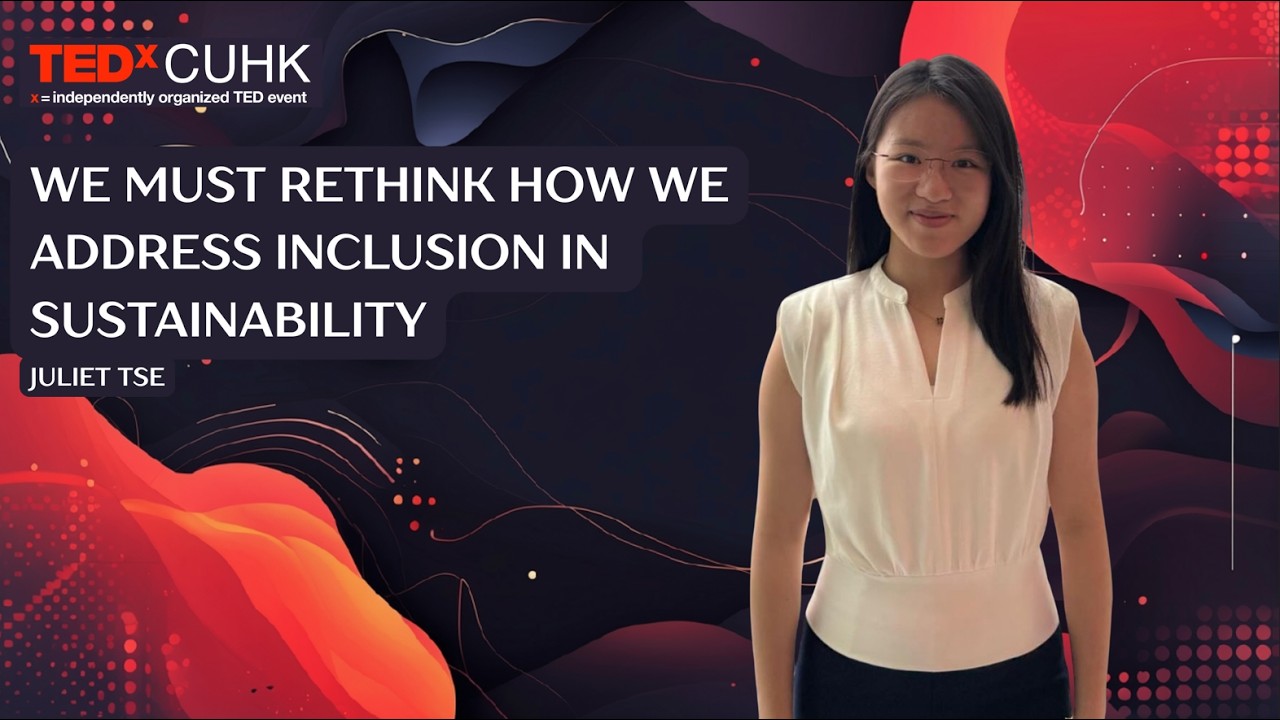
We Must Rethink How We Address Inclusion In Sustainability | Juliet Tse | TEDxCUHK
Title history
- We Must Rethink How We Address Inclusion In Sustainability | Juliet Tse | TEDxCUHK — observed on 20261101-0405 UTC (YouTube)
Keywords
Summary
133 words
Critical Evaluation
Value of the Information & Strength of the Argument
The value lies in the clear, relatable examples that connect workplace inclusion to global climate governance. The argument is structured logically, starting with personal anecdotes, moving to systemic critique, and presenting a new framework. However, the reasoning relies on illustrative cases rather than empirical evidence, and the proposed SCI model is introduced without deep operational detail. The argument is compelling but could benefit from stronger evidence for the claimed causal links between inclusion and sustainability outcomes.
Scientific Rigor, Source Quality, Title Accuracy
The talk references the International Labor Organization and mentions COP processes but provides no direct citations. The title matches the content accurately. The only external source provided in the description is the general TEDx link, which offers no specific supporting data. Overall, the intellectual rigor is moderate; the speaker’s expertise is evident, but the presentation would be strengthened by citing specific studies or reports.
155 words
Title / Content Match
The title accurately reflects the central thesis that current sustainability efforts overlook inclusion and require a paradigm shift.
Quality & Reliability
7/10
The talk presents a coherent critique and proposal with some statistics (e.g., ILO data, philanthropic funding) but lacks precise citations or references in the presentation itself. The argument is persuasive but relies heavily on personal experience and anecdotal evidence.
Key Moments
Markers derived by PSI from the transcript: the creator did not define chapters.
- Introduction: Sustainability starts with people, not just power.
- Example of workplace inclusion: breastfeeding rooms and neurodivergent workspaces.
- Research on philanthropic investments in carbon capture; less than 2% of funding for climate mitigation.
- Critique of top-down models and history of COP conferences (Kyoto, Copenhagen, Paris).
- Introduction of the SCI model: Sustainability, Connection, Inclusion.
- Combining SCI with systems thinking to shift to human-centered processes.
- Call to action: notice moments of exclusion and take small steps towards inclusion.
Cited Sources
- TEDx Program — General information about independently organized TEDx events, referenced in the video description.
Contribution & Novelties
The speaker proposes a novel ‘SCI’ framework (Sustainability, Connection, Inclusion) that explicitly prioritizes structural inclusion in sustainability efforts. She shifts the discourse from a top-down, metric-driven approach to a human-centered process. The originality lies in connecting workplace inclusion examples with global climate governance, arguing that inclusion is not a secondary concern but a prerequisite for effective sustainability. The integration of contemporary systems thinking provides a visualizable method for mapping stakeholder interrelationships.
Pour aller plus loin :
- Systems thinking — A foundational concept for understanding interrelationships and wholes, directly relevant to the proposed framework.
- Inclusive development — An approach that emphasizes equity and participation, aligning with the talk’s core message.
- Climate governance — Overview of how decisions are made in climate policy, useful for understanding the COP critique and structural inclusion challenges.
131 words
Radar Profile
The radar profile shows balanced scores across quantity, quality, and technique, but reliability trails slightly. This reflects a passionate and well-structured talk that relies on anecdotal evidence and lacks formal citations, making it engaging but not highly rigorous in a scientific sense.