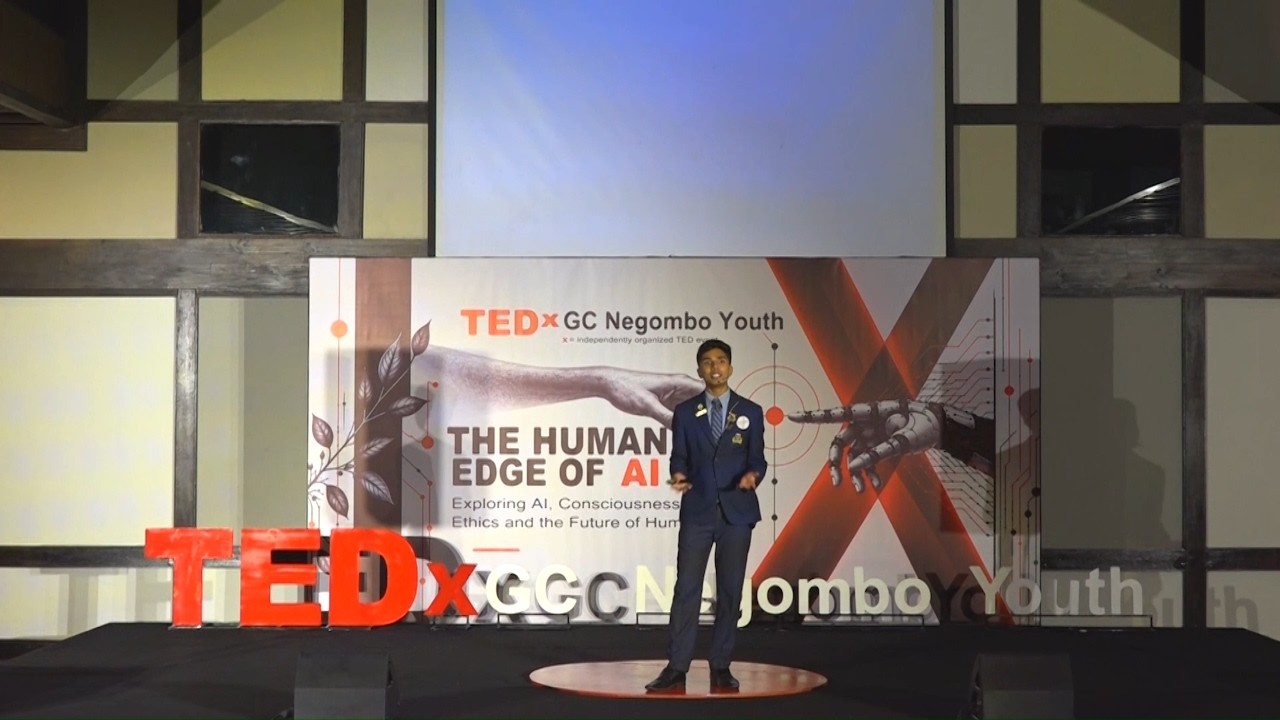
You are more than your data | Devin Jayakody | TEDxGC Negombo Youth
Title history
- You are more than your data | Devin Jayakody | TEDxGC Negombo Youth — observed on 20261101-0405 UTC (YouTube)
Keywords
Summary
148 words
Critical Evaluation
Value of the Information & Strength of the Argument
The value lies in making complex AI concepts accessible and juxtaposing them with human intentionality. The argument is coherent and persuasive, following a logical progression from similarities to differences. The speaker acknowledges limitations (biology, environment) and avoids overstatement, granting a degree of agency rather than absolute free will. However, the argumentation relies on anecdotal examples and personal introspection rather than empirical data, which weakens its scientific rigor but strengthens its philosophical appeal.
Scientific Rigor, Source Quality, Title Accuracy
The talk does not cite specific studies or external sources; it presents general knowledge about neural networks and AI. The only provided link is the general TEDx page, indicating a lack of explicit references. The title is well-matched to the content, but the lack of measurable evidence reduces scientific rigor. No audience comments were analyzed to gauge public reception.
146 words
Title / Content Match
The title accurately reflects the talk's central thesis that humans are not reducible to predictive data, though the content also covers similarities between human cognition and AI.
Quality & Reliability
6/10
The talk offers a compelling but largely philosophical perspective without citing specific scientific studies. General concepts about pattern recognition and AI are accurately presented, but the argument relies on anecdotal reasoning rather than empirical evidence.
Key Moments
Markers derived by PSI from the transcript: the creator did not define chapters.
- Introduction to pattern recognition in humans using everyday examples.
- Explanation of how humans learn to recognize cats through repeated exposure.
- Contrast between traditional computer programs and AI's learning-based approach.
- Social media recommendation systems as an example of AI predicting human behavior.
- Discussion of AI's statistical nature and its limitation in predicting human decisions.
- Human ability to break patterns through conscious reflection and agency.
- Concluding remarks on reconstructive memory and the privilege of choosing one's path.
Cited Sources
- TEDx Program — General link to the TEDx platform, indicating the event's origin and format.
Contribution & Novelties
The talk offers a fresh perspective by framing human uniqueness not in terms of intelligence or unpredictability, but in the ability to consciously override learned patterns. It bridges cognitive science and AI ethics in an accessible way, though it adds little new empirical insight.
Pour aller plus loin :
- Neural network — Foundation of AI pattern recognition.
- Recommender system — Mechanism behind social media predictions.
- Free will — Philosophical concept relevant to human agency.
- Reconstructive memory — Cognitive basis for reinterpretation of past events.
84 words
Radar Profile
The profile shows moderate information quantity and quality with low technical depth, reflecting an accessible yet philosophically oriented talk. Reliability is average due to lack of citations, but the coherent argumentation compensates somewhat.