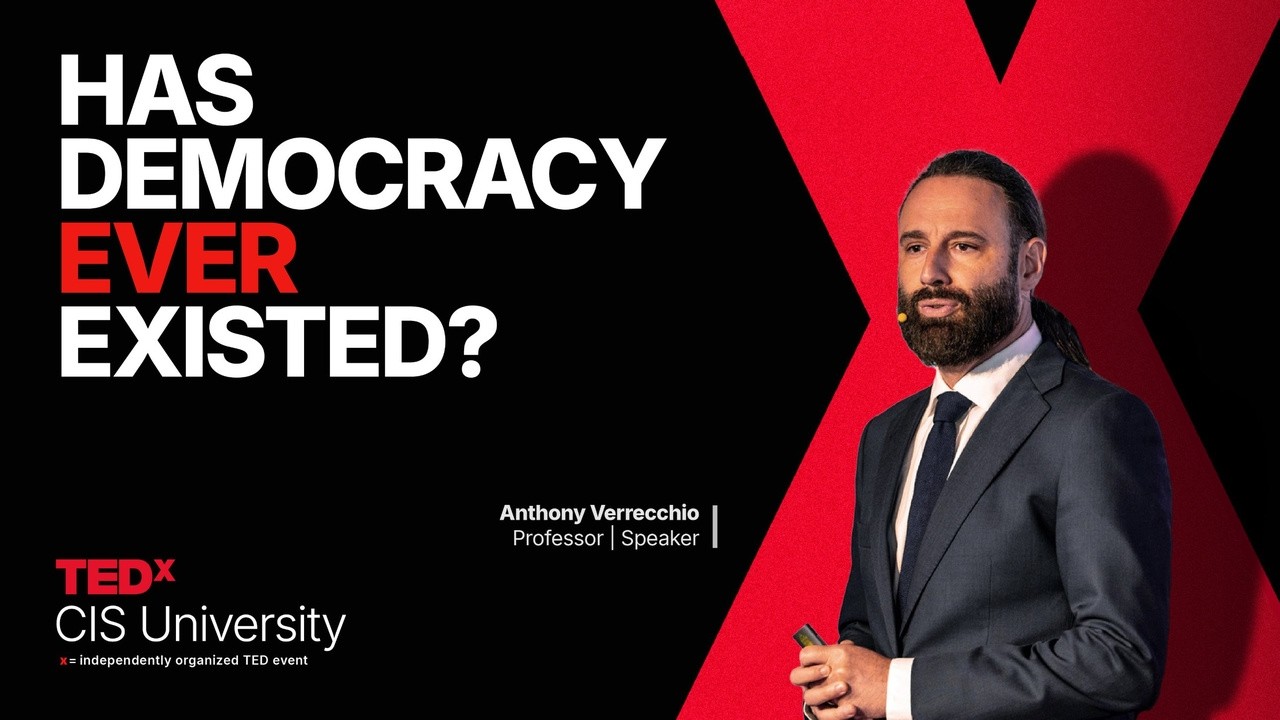
Who needs democracy? | Anthony Verrecchio | TEDxCIS University
Title history
- Who needs democracy? | Anthony Verrecchio | TEDxCIS University — observed on 20261104-2220 UTC (YouTube)
Keywords
Summary
154 words
Critical Evaluation
Value of the Information & Strength of the Argument
The value lies in reframing democracy as a complex system of interdependent conditions rather than a mere electoral procedure. Verrecchio effectively connects Enlightenment philosophy with modern human rights doctrine, making the argument intellectually coherent. His reasoning is logically structured: he defines the problem, explains the necessary components, and offers concrete recommendations (e.g., ‘do the homework’, ‘don’t outsource your thinking’). He acknowledges counterpoints, such as countries with ‘democratic’ in their names being authoritarian, though he avoids deep empirical analysis. The argumentation is persuasive in its clarity and moral appeal, but it remains abstract and lacks quantitative or comparative data to support claims about contemporary democratic deficits.
Scientific Rigor, Source Quality, Title Accuracy
Scientific rigor is moderate. The speaker cites canonical sources (Kant’s essay, UDHR) but does not provide precise references or verify empirical claims. He mentions specific countries without presenting data or studies. The talk is more of an informed opinion than a rigorous analysis. The title ‘Who needs democracy?’ is not fully addressed; the content instead explains why democracy is necessary and how to strengthen it, making the title somewhat misleading relative to the body. The TEDx description provides only the official TEDx link, which does not add substantive references. No audience comments were provided for analysis.
216 words
Title / Content Match
The title is provocative and rhetorically asks who needs democracy, but the content focuses on what democracy requires and why it is essential, rather than directly answering 'who'. The fit is partial.
Quality & Reliability
7/10
The talk relies on well-known philosophical and legal references (Kant, Universal Declaration of Human Rights) but provides no detailed citations or empirical evidence. It is opinion-driven and lacks systematic rigor, though it presents coherent reasoning.
Key Moments
Markers derived by PSI from the transcript: the creator did not define chapters.
- Introduces the question: 'Has democracy ever existed?' and asks the audience to define democracy, suggesting most would say 'voting'.
- Argues that democracy requires prerequisite conditions: education, a free press, and accountability for rule-breaking. Emphasizes interdependence.
- References Immanuel Kant's 1784 essay 'What is Enlightenment?' and the phrase 'Sapere aude' (dare to know), linking to the courage to use one's own knowledge.
- Discusses the Universal Declaration of Human Rights, focusing on Articles 19 (expression), 21 (political participation), 26 (education), and 29 (duties to society).
- Calls for building community and open dialogue, stressing that democracy cannot tolerate hatred or laziness, and concludes with an optimistic note about continuous improvement.
Cited Sources
- TEDx Program — The talk was given at a TEDx event, as stated in the video description.
Contribution & Novelties
The talk offers a refreshing emphasis on the need for independent judgment and intellectual courage as foundational to democracy, moving beyond typical discussions of electoral processes. It synthesizes Enlightenment ideas with contemporary human rights frameworks, highlighting the role of education and honesty in sustaining democratic societies.
Pour aller plus loin :
- Universal Declaration of Human Rights — Directly referenced in the talk; essential for understanding the human rights basis of democratic ideals.
- What Is Enlightenment? (Kant) — The essay cited by the speaker; foundational to the argument about ‘daring to know’.
- Democracy — For a broader theoretical context on democratic systems and their variations.
104 words
Radar Profile
The radar profile shows moderate scores across all dimensions, with a balanced distribution. Quality and reliability are slightly higher than technical level, reflecting an accessible talk grounded in established philosophical and legal references but lacking advanced empirical depth.