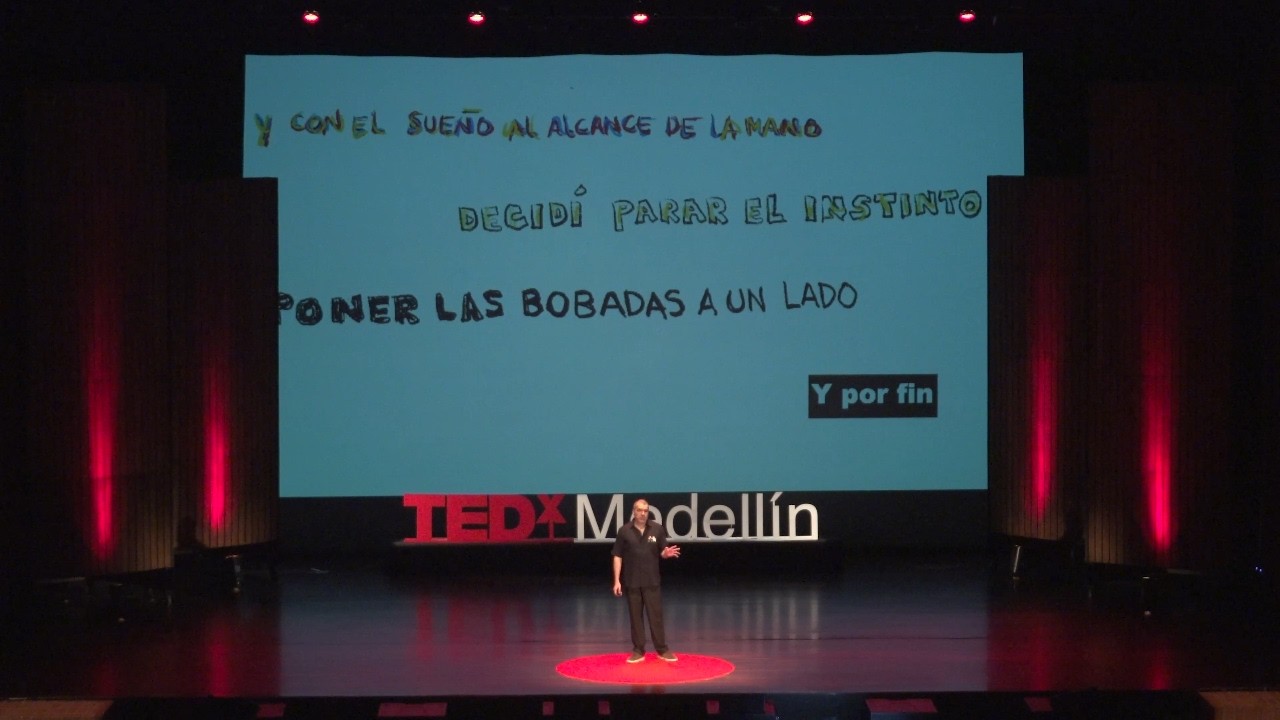
¿Por qué el artista cruzó la calle? | Simón Wilches | TEDxMedellin
Why Did the Artist Cross the Road? | Simón Wilches | TEDxMedellin
Title history
- ¿Por qué el artista cruzó la calle? | Simón Wilches | TEDxMedellin — observed on 20261101-0409 UTC (YouTube)
Keywords
Summary
205 words
Critical Evaluation
Value of the Information & Strength of the Argument
The talk’s value lies in its authentic personal testimony and the powerful metaphor of the ‘amoeba’ as an alternative to linear success. Wilches offers a compelling critique of productivity-driven culture, emphasizing the importance of intrinsic motivation, curiosity, and maintaining a childlike wonder. While argumentation is largely anecdotal and lacking empirical evidence, it is intellectually coherent and resonates with psychological concepts such as flow and intrinsic motivation. The story is engaging and well-structured, though it remains an opinion piece rather than a rigorous scientific contribution.
Scientific Rigor, Source Quality, Title Accuracy
The talk adheres to the TEDx format and cites only the standard TEDx resource (ted.com/tedx). No external sources or studies are referenced, which is typical for personal-experience talks. The title—‘Why did the artist cross the road?’—is a clever allusion to a classic joke and perfectly encapsulates the message about following creative instincts, showing a strong alignment between title and content. The public reaction (based on the limited engagement metrics) suggests a positive reception, though detailed comment analysis is not possible due to lack of data.
184 words
Title / Content Match
The playful, metaphorical title matches the central question and the talk’s narrative.
Quality & Reliability
8/10
Personal narrative based on professional experience in animation; coherent and authentic account, though subjective and non-empirical.
Key Moments
Markers derived by PSI from the transcript: the creator did not define chapters.
- Introduction: introducing himself and the question of why the artist crossed the road.
- Story about Solvang, California, and crossing the street for a photo of a pig and gnome.
- Reflection on creative instinct and childhood in Popayán, watching cartoons and drawing.
- Career success in Hollywood, burnout during pandemic, and redefining progress as an 'amoeba'.
- Journey to Chimaltenango, Guatemala, to see the folk dance festival after nine years.
- Conclusion: embracing the 'pig and gnome' and the importance of crossing streets.
Cited Sources
- TEDx Talks — Information about TEDx events and format.
Contribution & Novelties
The talk offers a fresh metaphorical framework (‘progress as an amoeba’) to argue for integrating one’s past and playful self into professional life. It challenges conventional notions of success and productivity, emphasizing the role of curiosity and ‘useless’ pursuits in sustaining creativity.
Pour aller plus loin :
- Flow (psychology) — Relevant to the immersive engagement with creative activities described by the speaker.
- Curiosity — Directly related to the drive to explore without instrumental goals.
- Divergent thinking — Connected to the open-ended, playful idea generation highlighted in the talk.
88 words
Radar Profile
The radar profile shows relatively balanced scores, with quality of information and reliability slightly higher than technical depth, reflecting a personal narrative with strong emotional resonance but limited formal scientific grounding.