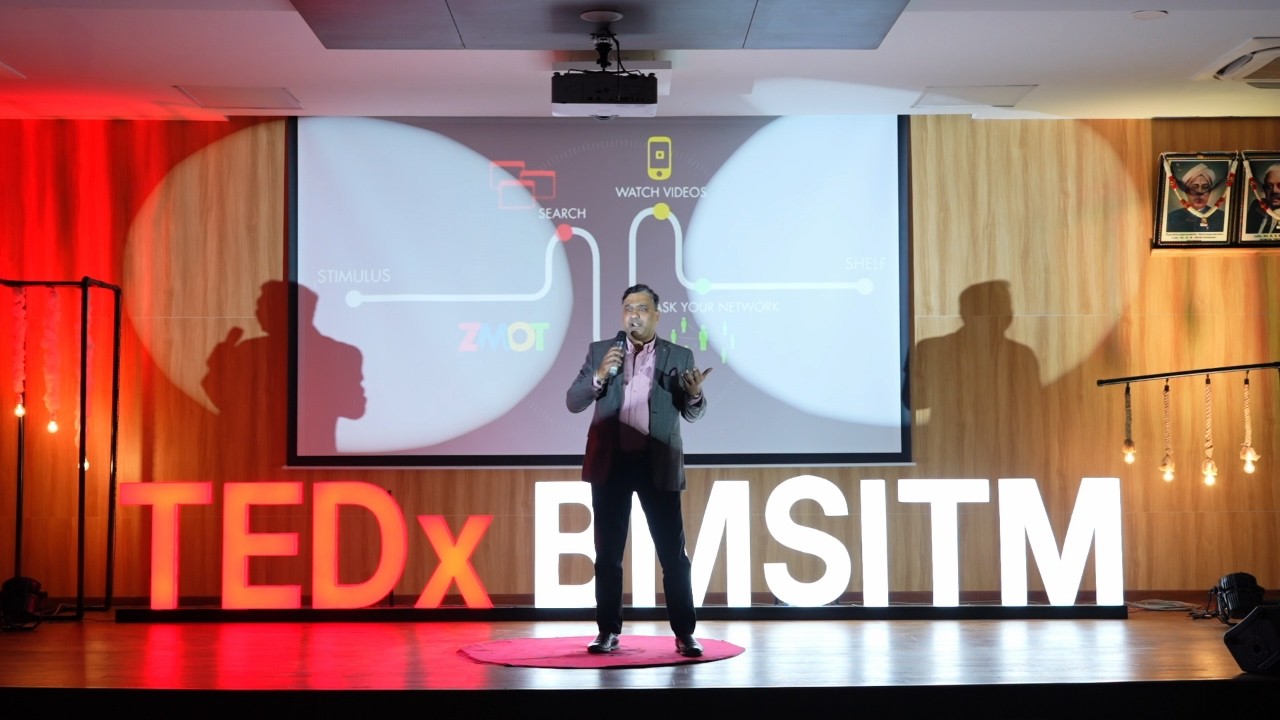
Implications, Effects & Future of AI in Marketing | Kiran Mandrawadkar | TEDxBMSITM
Title history
- Implications, Effects & Future of AI in Marketing | Kiran Mandrawadkar | TEDxBMSITM (PSI archive)
- Implications, Effects & Future of AI in Marketing | Kiran Mandrawadkar | TEDxBMSITM — observed on 20261104-2227 UTC (YouTube)
Keywords
Summary
197 words
Critical Evaluation
Value of the Information & Strength of the Argument
The talk provides valuable practical insights from an experienced marketer, illustrating how AI is integrated into everyday marketing decisions. The argumentation is built on anecdotal evidence and industry examples rather than rigorous data, but it effectively communicates key trends such as predictive analytics, generative AI, and the shift from traditional search to LLM-based queries. The speaker’s argument that AI should be a collaborative tool is sound, though the reasoning relies heavily on personal experience rather than academic references.
Scientific Rigor, Source Quality, Title Accuracy
The scientific rigor is moderate; the talk lacks citations or references to studies, relying instead on general knowledge and unverified examples like the Target case. The only external link in the description is to TEDx, which serves as a general platform reference. The title adequately captures the scope of the content, which promises a comprehensive look at AI’s implications, effects, and future in marketing, and the talk does address these points. However, the depth of analysis is limited, and the audience is not directed to further resources.
180 words
Title / Content Match
The title accurately reflects the content, covering implications, effects, and future trends of AI in marketing.
Quality & Reliability
5/10
The talk offers personal insights and industry examples, but lacks rigorous sourcing, scientific depth, and fails to cite specific research or data to support claims.
Key Moments
Markers derived by PSI from the transcript: the creator did not define chapters.
- Introduction and background of the speaker as a digital marketer.
- Target example illustrating predictive analytics and its impact on consumer profiling.
- Discussion on doom scrolling and the need for 'thumbs stop' marketing.
- Explanation of the zero moment of truth and its role in consumer decision-making.
- Contrast between traditional search and generative AI era, with examples of LLM optimization.
- Introduction of four types of AI intelligence for brands: competitor, marketplace, sales & opportunity, and brand visibility.
- The three aspects of AI: interaction, imitation, and inspiration, with a call to work alongside AI.
Cited Sources
- TEDx Talks — General platform for independently organized TED-like events; mention of the TEDx license.
Contribution & Novelties
This talk offers a practitioner’s perspective on how AI transforms marketing, particularly by framing the shift from traditional search to generative engine optimization and introducing a simple taxonomy (competitor, marketplace, sales & opportunity, brand visibility intelligence). It emphasizes the need for marketers to adapt to AI-driven consumer behavior while warning against over-reliance. The ’three I’s’ (interaction, imitation, inspiration) provide a memorable framework.
Pour aller plus loin :
- Zero Moment of Truth (ZMOT) — A concept referenced in the talk; explains the critical consumer research phase before purchase.
- Predictive Analytics — Underpins the Target example; discusses techniques used to forecast customer behavior.
- Generative Artificial Intelligence — Core to the ‘GPT era’ described by the speaker; details how generative models create content.
- Large Language Models (LLM) optimization — Mentioned without URL; refers to the practice of optimizing content for AI-driven search and chatbots.
141 words
Radar Profile
The radar profile shows moderate scores across all dimensions, with relatively higher quantity of information but lower technical depth and source reliability, reflecting a talk that is informative but not deeply rigorous.