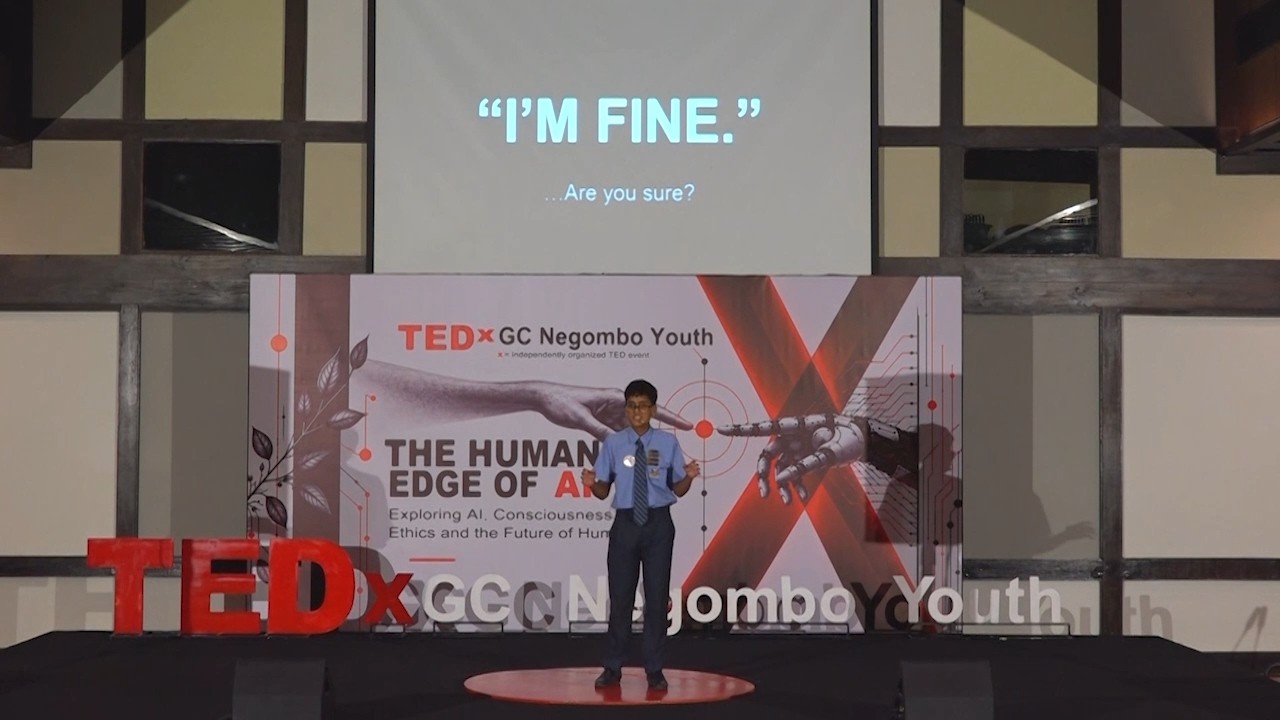
Can AI Hear what we don’t say? | Sadew Rangana | TEDxGC Negombo Youth
Title history
- Can AI Hear what we don’t say? | Sadew Rangana | TEDxGC Negombo Youth — observed on 20261101-0410 UTC (YouTube)
Keywords
Summary
113 words
Critical Evaluation
Value of the Information & Strength of the Argument
The talk’s value lies in its personal reflections and accessible examples. The argument is coherent: communication vs connection, AI lacks lived experience, so empathy remains human. However, it lacks empirical evidence and does not engage with counterarguments. The reasoning is anecdotal but logically consistent.
Scientific Rigor, Source Quality, Title Accuracy
No scientific sources are cited; the talk is based on personal experience. The title is apt as it poses a question that the talk addresses directly. The absence of empirical references reduces scientific rigor, but for a TEDx talk aiming to provoke reflection, it is acceptable. The speaker does not claim to present research, so the lack of sources is not a major flaw.
123 words
Title / Content Match
The title accurately captures the central question about AI's ability to perceive unspoken emotional cues, which the talk addresses directly.
Quality & Reliability
6/10
The talk relies on personal anecdotes and logical reasoning without empirical data or external sources. It offers a thoughtful but subjective perspective, making it moderately reliable as an opinion piece.
Key Moments
Markers derived by PSI from the transcript: the creator did not define chapters.
- Opening with AI advice and personal context
- First acting competition experience and the feeling of connection
- Forgetting lines and learning that connection requires more than perfect words
- Differentiating listening from waiting to speak
- AI's ability to describe emotions vs. experiencing them; empathy as human value
- Conclusion urging better human connection and asking one more time if someone is really fine
Cited Sources
- TEDx Talks — Reference for the TEDx event and format
Contribution & Novelties
The talk offers a personal and performative perspective on AI and empathy, emphasizing that lived experience is a key differentiator. It reframes the AI debate from capability to human improvement.
Pour aller plus loin :
- Empathy — Core concept explored in the talk.
- Theory of mind — Relates to AI’s difficulty in understanding unspoken mental states.
- Active listening — Directly relevant to the speaker’s advice on listening vs. waiting to speak.
- Turing test — Historical benchmark for AI communication, contrasted with empathy.
82 words
Radar Profile
The radar profile shows moderate information quantity and quality, low technical level, and moderate reliability. This reflects a personal reflection rather than a technical or evidence-based analysis.