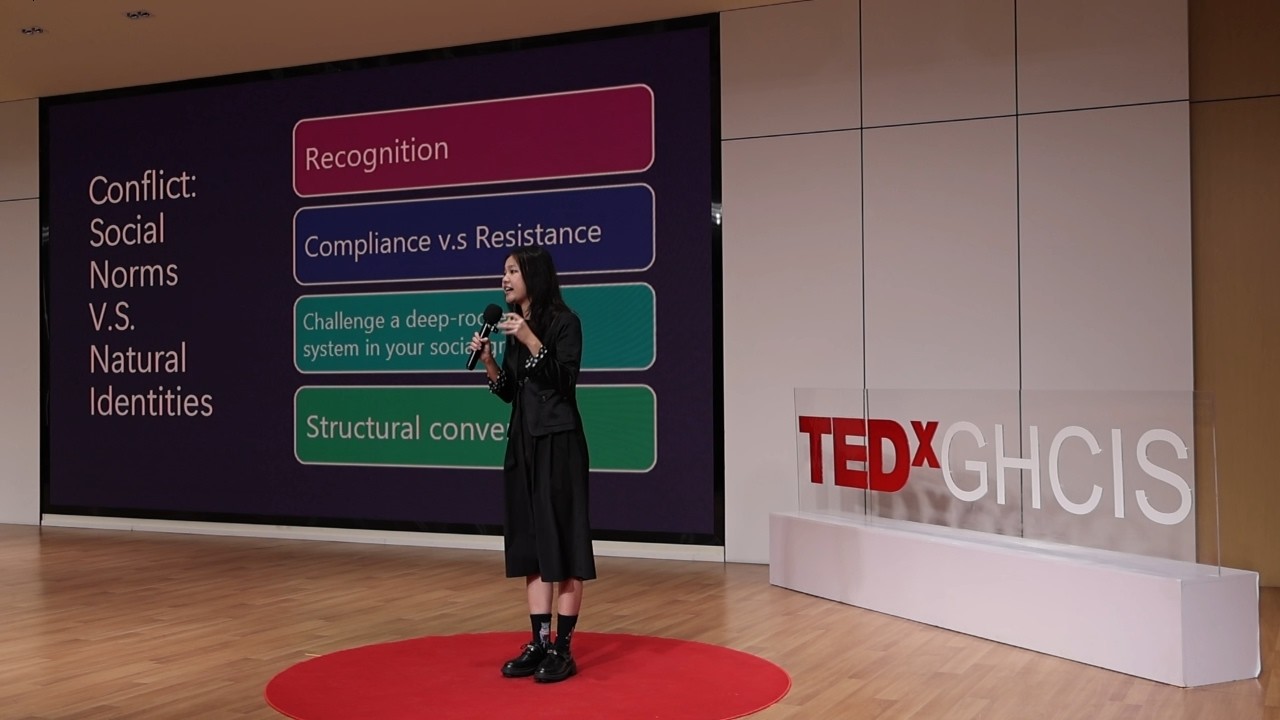
Conflict: Social Expectation v.s. Natural Identity | Xinyan Sun | TEDxGHCIS Youth
Title history
- Conflict: Social Expectation v.s. Natural Identity | Xinyan Sun | TEDxGHCIS Youth — observed on 20261101-0405 UTC (YouTube)
Keywords
Summary
145 words
Critical Evaluation
Value of the Information & Strength of the Argument
The talk offers valuable insights into how deep-rooted social norms perpetuate violence and limit individual freedom, particularly for women. The argumentation is clear and logically structured, moving from shocking statistics to personal narratives and ending with a call to action. The speaker’s use of anecdotal evidence and a survivor’s story strengthens the emotional appeal, though the reliance on unverified statistics and the lack of rigorous academic references weakens the scientific foundation. The reasoning that compliance or rebellion are the two paths oversimplifies the spectrum of responses, but the speaker acknowledges this by suggesting incremental shifts. Overall, the information is useful for raising awareness, but the argument would benefit from citing specific studies or reports.
Scientific Rigor, Source Quality, Title Accuracy
The talk relies on publicly available statistics (e.g., every 11 minutes a woman is killed, 5,000 honor killings, 230 million FGM survivors) but does not name the original sources, making verification difficult. The speaker mentions a ‘Hula Packer report’ about job application rates, but this reference appears obscure and may be an inaccurate version of the often-cited Hewlett Packard study. The title accurately reflects the content, which focuses on the clash between social expectations and natural identity, with gender as the central lens. The talk is well-structured, but the absence of external citations and the heavy reliance on personal testimony limit its rigor. No audience comments were provided for analysis.
239 words
Title / Content Match
The title accurately reflects the core theme of conflict between social expectations and natural identity, as illustrated through gender-based violence and normative pressures.
Quality & Reliability
6/10
The talk provides compelling statistics and personal anecdotes, but lacks explicit citations for most figures. The speaker's perspective is personal and experiential, though the underlying issues are well-documented globally. The content is plausible but not rigorously sourced within the video.
Key Moments
Markers derived by PSI from the transcript: the creator did not define chapters.
- Speaker introduces disturbing statistics on violence against women (honor killings, FGM).
- Discussion of internalization of social norms and how they shape behavior.
- Personal anecdotes about being ignored in a shop and father's emotional suppression.
- Introduction of the two paths: compliance vs rebellion.
- Story of Nina Oak, survivor of honor violence, and her charity work.
- Call to action: recognizing conflicts, supporting survivors, and collectively challenging norms.
Cited Sources
- TEDx Program — Official TEDx channel and program information, as referenced in the video description.
Contribution & Novelties
The talk brings a personal and reflective perspective on the intersection of social expectations and natural identity, drawing attention to extreme manifestations like honor killings and FGM while linking them to everyday microaggressions. It emphasizes the internalization of norms and the need for collective action. The inclusion of a survivor’s story adds a powerful human dimension.
Pour aller plus loin :
- Honor killing — Essential background on the definition, prevalence, and cultural contexts.
- Female genital mutilation (Wikipedia) — Comprehensive overview of practices, health consequences, and global efforts to end it.
- Internalization of norms (Sociology) — Theoretical framework on how individuals adopt social values.
- Nina Oak’s charity? — Note: This URL is uncertain; the charity might have a different official site. The context mentions her charity but no link is provided, so this is unverified.
134 words
Radar Profile
The radar profile shows a balance between quantity and quality of information, with moderate technical depth and reliability. The talk is informative but not highly technical, and its reliability is limited by lack of explicit sourcing. The overall score is average, indicating a thought-provoking but not deeply rigorous content.