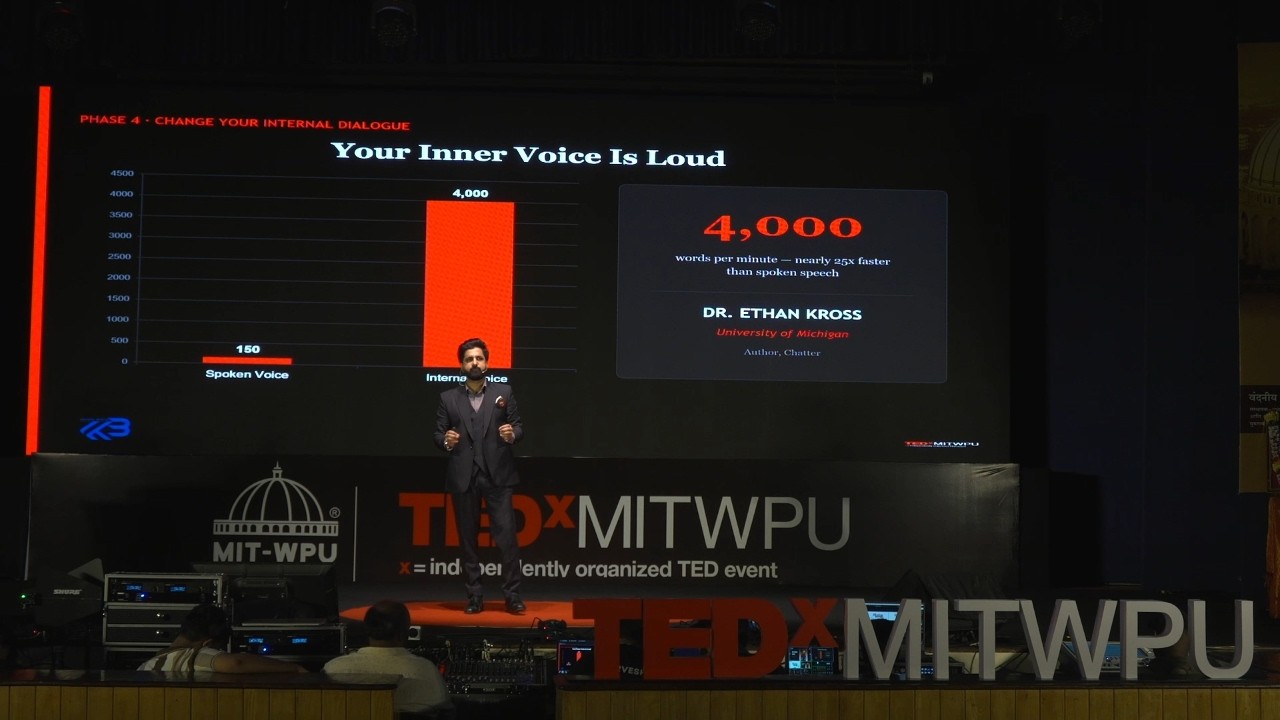
Why your inner dialogue shapes how the world hears you | Kunal Buch | TEDxMITWPU
Keywords
Summary
173 words
Critical Evaluation
Value of the Information & Strength of the Argument
The talk provides practical, actionable advice for improving self-talk and communication, which may benefit individuals seeking personal growth. The argumentation is primarily anecdotal, relying on the speaker’s own journey and motivational examples rather than systematic evidence. The reference to research adds credibility but is presented loosely without specific details or study names beyond the authors. The two-question method (‘Can I change it?’ / ‘What next?’) is simple and potentially helpful for reframing setbacks. The 21-day practice is concrete and easy to implement, but its efficacy is asserted without empirical support. The overall argument is coherent and persuasive from a motivational standpoint, but lacks scientific depth.
Scientific Rigor, Source Quality, Title Accuracy
The speaker, Kunal Buch, is a professional coach, not a researcher, but he references legitimate psychological studies (e.g., by Ethan Kross, Ozlem Ayduk, Killingsworth & Gilbert). No direct citations are provided in the video or description; only the TEDx page is linked. The title accurately represents the content, and the talk stays on topic. While the claims about thought rates and mind-wandering are plausible and traceable to published research, the lack of explicit references reduces rigorous verification. The description includes a link to the TEDx program, but no additional sources are offered. Overall, the content is credible in its general claims but lacks the transparency expected in a strictly scientific presentation.
231 words
Title / Content Match
The title accurately reflects the core message: the internal dialogue (inner voice) influences external communication and how others perceive us.
Quality & Reliability
6/10
The talk cites specific research by Ethan Kross, Ozlem Ayduk, and Killingsworth & Gilbert, and presents statistical claims (e.g., 4,000 self-talk thoughts per minute, 46.9% of waking time in mind-wandering) that align with published studies, but provides no direct citations or sources in the video itself. Personal anecdotes are used to illustrate points, which weakens rigorous verification.
Key Moments
Markers derived by PSI from the transcript: the creator did not define chapters.
- Introduction: the mirror metaphor and the inner voice we check every morning.
- Personal story of academic failure and the turning point where he decided to trust his own voice.
- Communication model: what we think + feel + sound + express; the Ferrari-Fiat analogy.
- Research claims: 150 words/min vs 4,000 thoughts, and 46.9% of waking time in mind-wandering.
- The two questions: 'Can I change it?' and 'What next?' to escape stuck situations.
- 21-day practice: morning voice check, midday energy check, and three nightly wins.
- Conclusion: commitment to practice and closing message about doing what others won't.
Cited Sources
- TEDx Talks — Official TEDx page mentioned in the video description; the talk was given at a TEDx event.
Contribution & Novelties
The talk synthesizes well-known psychological concepts (self-talk, mind-wandering) into a practical framework for communication and personal development. Its originality lies in the actionable 21-day routine and the simple two-question resilience tool, which may be novel for a general audience. However, it does not present new research; it repackages existing findings for motivational purposes.
Pour aller plus loin :
- Ethan Kross - Psychology of self-talk — Directly relevant: Kross is a leading researcher on inner speech and mind-wandering, central to the talk’s claims.
- Mind-wandering (Killingsworth & Gilbert) — Supports the 46.9% statistic; the referenced study is a landmark on the prevalence of wandering thoughts.
- Internal monologue — General concept of the inner voice, foundational to the talk’s theme.
- Personal development — Broader context of the talk’s practical advice on self-improvement.
129 words
Radar Profile
The profile shows moderate information quantity and quality, with low technical depth and moderate reliability. This aligns with a motivational talk that cites research but stays at a surface level.