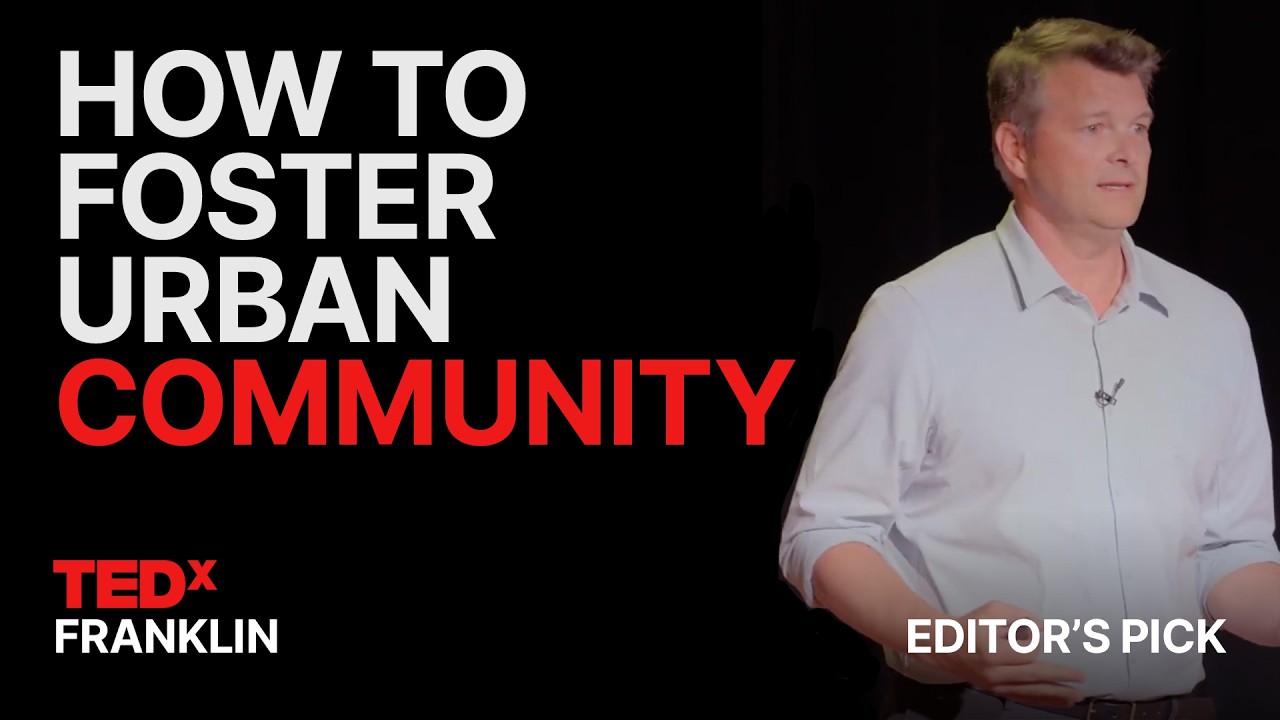
Why do cities make us lonely? | Craige Hoover | TEDxFranklin
Keywords
Summary
147 words
Critical Evaluation
Value of the Information & Strength of the Argument
The value of the talk lies in its accessible synthesis of key concepts like the mere exposure effect and social capital, applied to urban design. The argument is coherent: the speaker identifies a problem (loneliness and distrust), cites evidence (Chetty’s study), and proposes a solution (flexible zoning and incremental development). The narrative is persuasive, using a personal story from Seaside to illustrate how small experiments can lead to vibrant communities. However, the argumentation is somewhat one-sided, lacking counterarguments or acknowledgments of trade-offs such as housing affordability or infrastructure costs. The speaker’s authoritative tone is bolstered by his professional background, but the scientific depth is limited.
Scientific Rigor, Source Quality, Title Accuracy
The talk maintains a clear alignment with the title, focusing on the relationship between urban design and loneliness. The speaker cites two types of sources: psychological research (the mere exposure effect) and economic research (Raj Chetty’s work on economic connectedness). While these are relevant and credible, no specific study details or citations are provided, and the references remain general. The only direct source link in the description is the TEDx program page, which does not lead to further scientific references. The talk is not a rigorous academic review but rather an opinion-based presentation grounded in some research. The title is apt and not misleading, accurately reflecting the content.
228 words
Title / Content Match
The title directly asks why cities make us lonely, and the talk addresses this through urban design, zoning, and community interaction. The content aligns well with the title.
Quality & Reliability
6/10
The talk cites one credible study (Raj Chetty) and a psychological concept (mere exposure effect), but relies largely on anecdotal experience and personal narrative. The scientific basis is present but not rigorously developed, and the speaker's expertise is in real estate development rather than research.
Key Moments
Markers derived by PSI from the transcript: the creator did not define chapters.
- Introduction: aversion to strangers and engineering a society without encounters.
- Comparison of modern society to an ecological monoculture, leading to loneliness.
- Discussion of trust and the mere exposure effect.
- Raj Chetty's research on economic connectedness as a key to upward mobility.
- Critique of zoning regulations and financial systems that prevent mixed-use development.
- Personal story of Seaside, Florida, and Robert Davis's 'generous design'.
- Call to action: say yes to new development, adapt zoning, and embrace experimentation.
Cited Sources
- TEDx Program — Official TEDx page providing information about the event and format.
Concurring Sources
- The mere exposure effect — Supports the claim that repeated exposure increases liking and trust.
- Raj Chetty's research on economic connectedness — Provides empirical evidence linking social interactions to economic mobility.
- New Urbanism principles — Aligns with the advocacy for walkable, mixed-use neighborhoods.
Contribution & Novelties
The talk’s original contribution lies in framing urban planning issues through the lens of ecological monocultures, making the concept of ‘monoculture’ actionable for a general audience. It connects psychological theories (mere exposure) with economic mobility research, offering a compelling narrative that urban design can directly impact social trust and opportunity. The speaker’s practical experience in placemaking adds a real-world perspective.
Pour aller plus loin :
- Mere exposure effect - Wikipedia — Core psychological concept used to explain trust building.
- Raj Chetty - Wikipedia — Economist whose research on economic connectedness is central to the talk.
- Economic connectedness - Opportunity Insights — Academic paper detailing the relationship between social connections and upward mobility.
112 words
Radar Profile
The scores indicate a balanced profile, with moderate-to-high information quantity and quality, medium technical depth, and moderate reliability. The talk is strong on engaging storytelling and practical insights but relatively weak on rigorous scientific sourcing. The overall note of 4/5 reflects its persuasive and well-structured nature, despite limitations in depth.