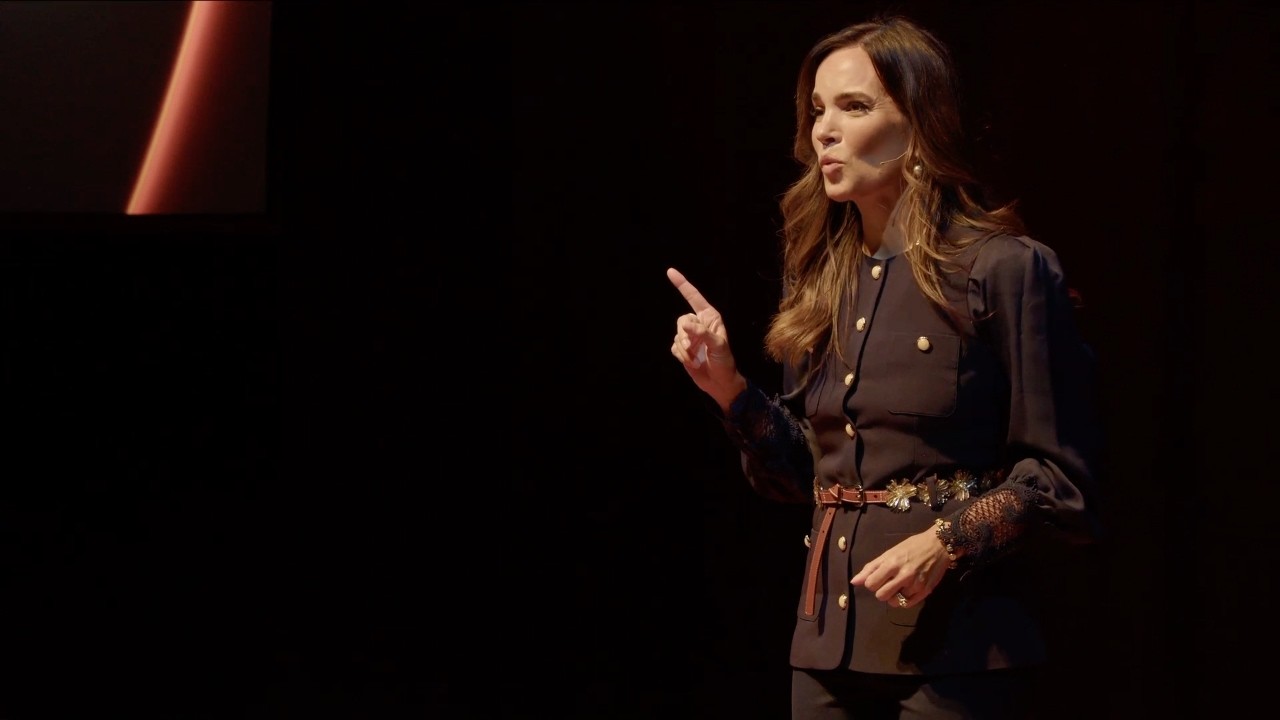
Audacious optimism! | Shanna Adamic | TEDxColumbiana
Title history
- Audacious optimism! | Shanna Adamic | TEDxColumbiana — observed on 20261106-0136 UTC (YouTube)
Keywords
Summary
140 words
Critical Evaluation
Value of the Information & Strength of the Argument
The talk’s value lies in its practical, easy-to-remember framework (catch, shift, step into it) that viewers can immediately apply. The argumentation is built on a powerful personal story, making it emotionally resonant rather than empirically rigorous. Adamic openly admits she did not initially believe her own affirmations, which adds authenticity. However, she does not provide scientific references or studies to support the efficacy of this approach, relying solely on anecdotal evidence. The reasoning is logical within its own terms, but the lack of external validation diminishes its persuasive force for a skeptical audience.
Scientific Rigor, Source Quality, Title Accuracy
The speaker cites no formal sources, aside from referencing her own book and the TEDx platform. The talk is well-structured and delivered with clear articulation, but it is not scientifically grounded. The title is directly aligned with the content, introducing and repeatedly defining ‘audacious optimism’. There is no evidence of misinformation, but the absence of cited literature limits the scientific rigor. The personal narrative is compelling but anecdotal, and the talk would benefit from referencing psychological concepts like cognitive reframing or self-affirmation to bolster credibility.
193 words
Title / Content Match
The title accurately reflects the central theme of 'audacious optimism', the concept introduced and developed throughout the talk.
Quality & Reliability
6/10
The talk presents a personal, anecdotal framework with no cited scientific evidence, but it is coherent and offers a practical method, balancing moderate reliability and emotional appeal.
Key Moments
Markers derived by PSI from the transcript: the creator did not define chapters.
- Introduction: Shanna describes staring at herself in the mirror after brain surgery and not recognizing her reflection.
- She recounts her diagnosis of a rare brain tumor, the 13-hour surgery, and permanent effects: deafness in one ear and facial paralysis.
- The mirror moment: she laughs, cries, and tells herself 'You're a total badass,' which becomes a turning point and the seed of 'audacious optimism'.
- She defines audacious optimism and presents the three-step method: catch it, shift it, step into it, using the quarterback audible metaphor.
- She demonstrates the method with examples and describes her recovery, concluding with the message: 'When your world shifts, shift your words.'
Cited Sources
- TEDx program page — The talk was given at a TEDx event using the TED conference format but independently organized by a local community.
Concurring Sources
- Cognitive reappraisal on Wikipedia — Supports the idea that changing how one interprets a situation can alter emotional responses, echoing the 'shift' step.
- Self-affirmation theory on Wikipedia — Provides theoretical background for using affirmations to maintain self-integrity in the face of threats.
Contribution & Novelties
The original contribution is the personal adaptation of cognitive reframing into a simple, memorable three-step framework (‘catch it, shift it, step into it’) that connects abstract optimism to concrete linguistic shifts. It emphasizes that words can precede belief, offering a bridge for individuals in unsettling transitions. While not novel scientifically, the packaging and personal narrative make it accessible and actionable for a broad audience.
Pour aller plus loin :
- Cognitive reappraisal — This psychological concept involves reinterpreting a situation to change its emotional impact, closely aligning with the ‘shift’ step in her method.
- Self-affirmation theory — Research on self-affirmation shows that affirming core values can protect against threats, supporting her practice of repeating positive statements.
- Growth mindset — Carol Dweck’s work on believing abilities can be developed parallels the shift from ‘I can’t do this’ to ‘I can learn how.’
140 words
Radar Profile
The radar profile shows moderate information quantity and quality, low technical depth, and moderate reliability, indicating this is an inspirational talk rather than a technical or evidence-based exposition. The balance suggests the content is engaging and practical but lacks scientific rigor.