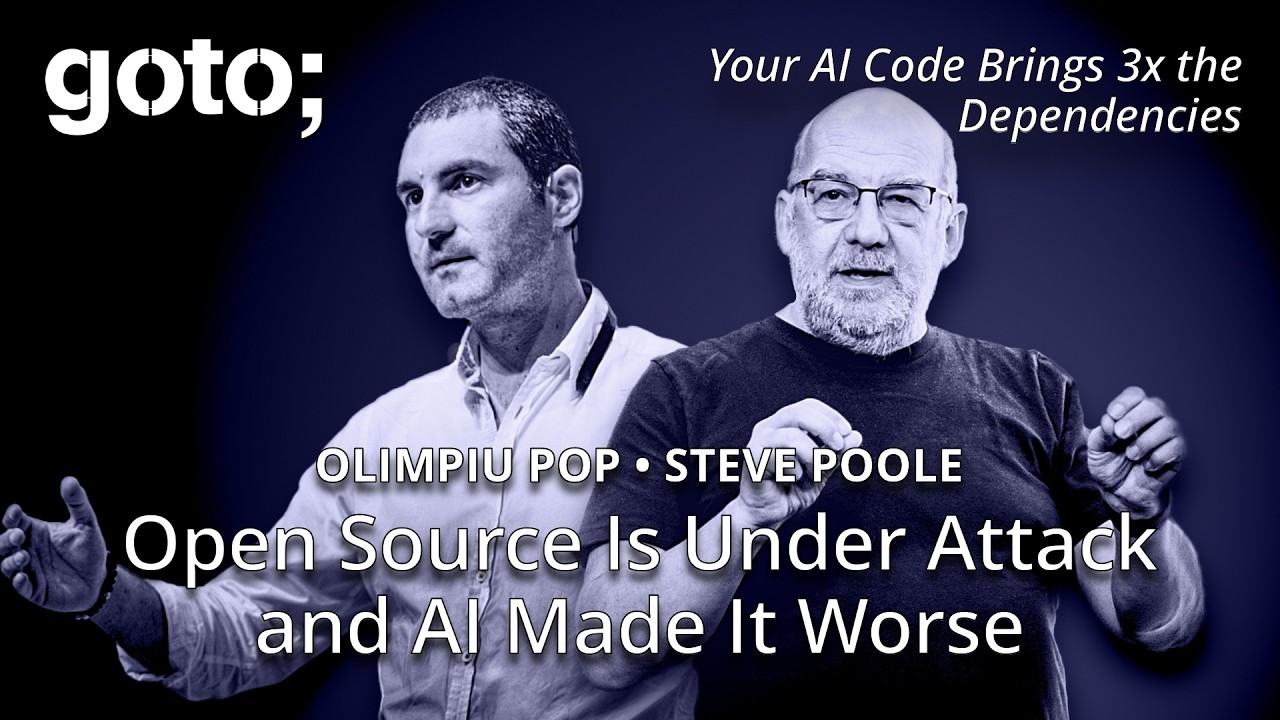
Open Source Is Under Attack & AI Made It Worse • Steve Poole & Olimpiu Pop • GOTO 2026
Keywords
Summary
188 words
Critical Evaluation
Value of the Information & Strength of the Argument
The value of this interview lies in its candid, expert perspective on the intersection of AI, regulation, and open-source sustainability. Poole’s argumentation is coherent and grounded in his extensive experience at Sonatype and HeroDevs. He identifies a plausible threat model: AI makes vulnerability discovery cheaper and broader, while the maintenance burden remains concentrated on a few volunteers. This asymmetry is persuasively linked to potential outcomes such as maintainer burnout and the commercialization of security fixes. The discussion is strengthened by concrete examples of attack techniques and practical advice (e.g., reducing dependencies, staying on maintained releases). However, the arguments are primarily anecdotal and lack empirical data or citations to studies, which limits their evidential weight. The interview does not engage with counterarguments or alternative viewpoints, and the reliance on ‘worst-case scenarios’ introduces a speculative element. Nonetheless, the clarity of reasoning and the insider perspective make it a useful contribution to the discourse on software supply chain security.
Scientific Rigor, Source Quality, Title Accuracy
The video is well-structured, with clear chapters and a focused topic. The rigor is moderate: while the speaker cites concepts like the CRA and Kubernetes AI policy, no primary sources are explicitly referenced within the conversation. The description provides links to social profiles, the GOTO site, and an article (gotopia.tech/articles/457) that may serve as further reading, but these are not formally cited during the discussion. The title accurately summarizes the content: the video does argue that open source is under attack and that AI has exacerbated the situation. There is no evident mismatch between title and content. The absence of peer-reviewed references and reliance on personal experience lowers the scientific rigor, but the interview is transparent about its nature as expert commentary. The video does not claim to present original research, so the adequacy is acceptable for an opinion piece. No comment data was provided, so audience reception cannot be assessed.
322 words
Title / Content Match
The title accurately reflects the discussion on open source vulnerability and AI's role.
Quality & Reliability
7/10
Expert speaker with extensive industry experience in software supply chain security, but the content is opinion-based without cited studies.
Chapters
Cited Sources
- GOTO Conference website — Official GOTO conference platform, likely where the interview is hosted.
- GOTO Unscripted article (related content) — Potential article accompanying the video, possibly elaborating on the topics discussed.
- Steve Poole's GitHub — GitHub profile of guest Steve Poole, possibly containing projects and resources.
- Olimpiu Pop's GitHub — GitHub profile of host Olimpiu Pop.
- Steve Poole's LinkedIn — LinkedIn profile of Steve Poole, providing professional background.
- Olimpiu Pop's LinkedIn — LinkedIn profile of Olimpiu Pop.
- GOTO on Bluesky — GOTO's official Bluesky account.
- GOTO on LinkedIn — GOTO conference company page on LinkedIn.
- GOTO YouTube channel subscription — Subscription link for GOTO Conferences channel.
Contribution & Novelties
This interview contributes by synthesizing current threats to open-source security with AI’s dual role as both a discovery accelerator and a risk amplifier. It highlights the under-reported pressure on maintainers and the potential for regulation and insurance to reshape the ecosystem. The discussion offers practical, actionable advice for developers, such as reducing dependencies and staying on maintained releases. It also underscores the often-overlooked responsibility of developers for AI-generated code, echoing policies like Kubernetes’. While the talk does not introduce entirely new research, it consolidates existing knowledge in an accessible format and adds an experienced practitioner’s perspective.
Pour aller plus loin :
- Cyber Resilience Act (CRA) — EU regulation designed to improve cybersecurity for digital products, referenced in the interview as a key driver for maintenance obligations.
- Software supply chain attack — A comprehensive overview of supply chain attack vectors, including typosquatting and compromised maintainers, which align with the video’s discussion.
- AI in cybersecurity — Explores how AI is used for both vulnerability discovery and defense, contextualizing the ‘industrialized discovery’ mentioned by Poole.
172 words
Radar Profile
The radar profile shows high information quantity and moderate quality, reflecting a dense discussion with actionable insights despite a lack of formal citations. Technical depth is moderate, suitable for a general developer audience. Global reliability is solid for an expert opinion, but the absence of empirical backup keeps it from being highly rigorous.