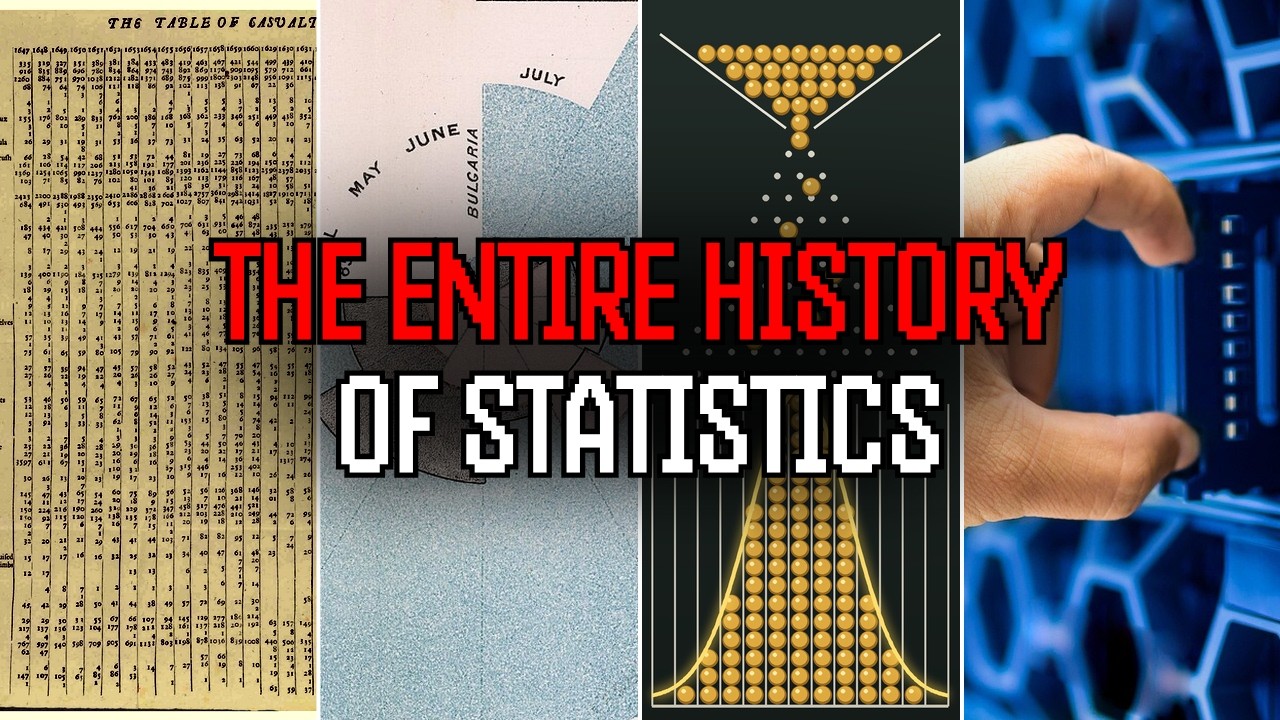
The Entire History of Statistics
Keywords
Summary
197 words
Critical Evaluation
Value of the Information & Strength of the Argument
The video provides substantial value by demystifying core statistical concepts through clear, concrete examples and by anchoring them in historical context. Its argumentation is robust: it consistently separates arithmetic operations from the interpretation of data, emphasizes the importance of data collection processes, and demonstrates how changing assumptions can alter conclusions. The use of simple numerical illustrations (e.g., farm counts, household size) makes the logic accessible without oversimplifying. The argumentation is careful and balanced, acknowledging that agreement between different estimation methods does not guarantee correctness and that missing data or definitional differences can compromise comparisons. The video excels in showing how to think critically about numbers from records, making it a valuable resource for understanding statistical reasoning beyond mere computation.
Scientific Rigor, Source Quality, Title Accuracy
The video demonstrates rigorous scientific thinking by consistently addressing the reliability and limitations of historical data. It references primary sources such as Graunt’s ‘Observations’ (1662), Petty’s essays (1687, 1690), and Halley’s life table (1693), and it correctly places them in their historical context. The narrative distinguishes between recorded data and the phenomena they are meant to represent, and it discusses issues like registration completeness, definitional changes, and the transferability of ratios across populations. The title ‘The Entire History of Statistics’ is ambitious; the content does provide a historical arc but is not encyclopedic, focusing on selected milestones to illustrate conceptual points. Overall, the title is both adequate and slightly modest, as the video offers deep methodological insights alongside historical narrative. The sources used are appropriate for a historical overview, and the presentation avoids sensationalism or unwarranted claims.
271 words
Title / Content Match
The title promises a comprehensive history, and while the video does cover key historical developments, it devotes considerable time to conceptual illustrations and methodological depth, making it more than a linear history. The content is consistent with the title but is broader than a chronological survey.
Quality & Reliability
8/10
The video provides a careful, methodical explanation of statistical reasoning, using historical examples and explicitly addressing limitations of records, assumptions, and interpretations. The narrative is nuanced, avoids oversimplification, and stresses the importance of understanding collection processes and underlying definitions. No external claims are made without acknowledging uncertainty, and the historical references are presented accurately.
Key Moments
Markers derived by PSI from the transcript: the creator did not define chapters.
- Introduces the clay tablet as an early record and the need to understand recording rules.
- Illustrates the farm example to explain how averages depend on data definitions and completeness.
- Discusses the importance of coverage and missing entries in registers.
- Introduces William Petty's political arithmetic and his population estimates for London.
- Examines sensitivity of Petty's estimates to assumed death rates and household sizes.
- Discusses John Graunt's analysis of London's bills of mortality and issues with historical categories.
- Explains Halley's life table construction and the role of conditional probabilities.
- Demonstrates the arithmetic of life tables with a hypothetical cohort and annuity valuation.
- Concludes with the importance of documenting assumptions and connecting records to broader questions.
Cited Sources
- Visual Sources Document (Google Docs) — The description provides this link as a source for visual materials referenced in the video.
Concurring Sources
- Visual Sources Document — This document likely lists the images and references used in the video, supporting the historical claims.
Contribution & Novelties
The video’s original contribution lies in its pedagogical approach: it systematically connects historical statistical works to the conceptual foundations of data analysis, emphasizing the importance of data-generating processes. It demystifies complex ideas such as coverage bias, assumption sensitivity, and conditional probability through simple examples, making them accessible to a broad audience. The video also highlights the continuous thread of methodological caution from early records to modern practice.
Pour aller plus loin :
- Political arithmetic — Historical term for early quantitative analysis of social and economic data; central to Petty’s work.
- John Graunt’s Observations — Graunt’s 1662 study of London’s bills of mortality is a foundational text in demography and statistics.
- Life table — A table showing survival probabilities by age; Halley’s construction was an early example used in actuarial science.
- Conditional probability — The concept is essential for understanding life table calculations and many statistical inferences.
146 words
Radar Profile
The radar profile shows high marks in quantity, quality, and technical level, with slightly lower reliability (still high). This suggests a well-researched, information-dense video with strong methodological depth, though the reliance on historical interpretation may make it less directly verifiable than a purely contemporary statistical presentation.