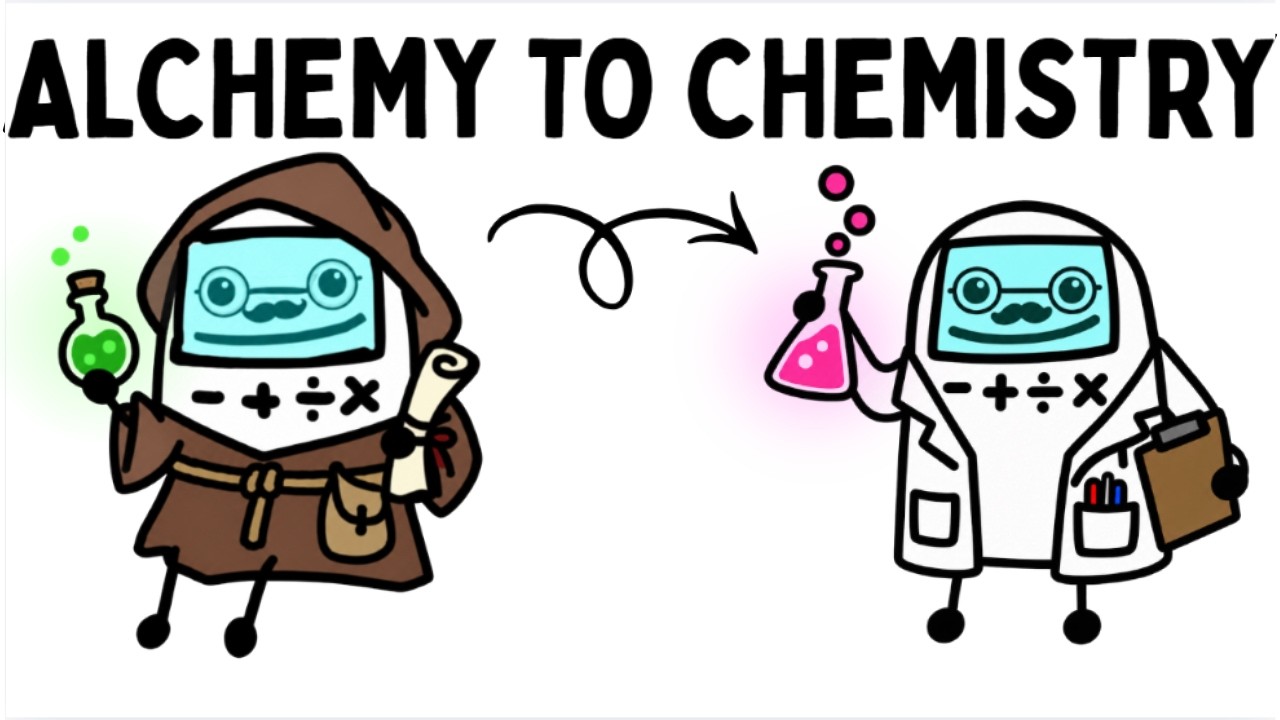
The Evolution From Alchemy To Chemistry Explained (For Sleep)
Title history
- The Evolution From Alchemy To Chemistry Explained (For Sleep) — observed on 20261028-1936 UTC (YouTube)
Keywords
Summary
186 words
Critical Evaluation
Value of the Information & Strength of the Argument
The value of the information lies in its careful, nuanced presentation of a complex historical process. The argumentation is solid: the video avoids teleological narratives, instead explaining how observations (like weighing metals) and practical operations contributed to conceptual shifts. It convincingly argues that alchemy and chemistry overlapped historically, and that judging past practices solely by modern criteria distorts our understanding. The reasoning is logical, consistently connecting practical examples to broader philosophical questions, and it emphasizes the importance of distinguishing between historical categories and modern concepts. This makes the content intellectually valuable for anyone interested in the history of science.
Scientific Rigor, Source Quality, Title Accuracy
The scientific rigor is moderate: the video presents a scholarly-sounding overview without explicitly citing sources within the spoken content. However, a visual sources document is linked in the description, which presumably lists references for the images used. The title is fully appropriate, as the video is designed as a sleep aid with a calm, continuous narration that matches the ‘For Sleep’ designation. The content itself seems well-informed, drawing on standard historical accounts, though the lack of in-text citations makes it difficult to verify specific claims. The overall structure is coherent, and the tone is informative without being dogmatic.
212 words
Title / Content Match
The title accurately reflects the content: a long, soothing narration covering the historical evolution from alchemy to chemistry.
Quality & Reliability
8/10
Presents a well-reasoned historical account with careful distinctions between ancient and modern concepts. The narrative is nuanced, avoiding oversimplification, and ties practical and theoretical aspects together. However, no in-text citations are given, reducing verifiability of specific claims.
Key Moments
Markers derived by PSI from the transcript: the creator did not define chapters.
- Introduction: heating a metal in air, gaining mass, and the challenge of weighing closed vs open systems.
- Discussion of practical classifications in craftsmanship, how materials are judged by operations, and the distinction between useful products and pure substances.
- Exploration of elemental theories, Aristotle's four elements, and the difference between philosophical principles and modern chemical elements.
- Early modern chemistry: Robert Boyle's critiques, the relation between alchemy and chemistry, and the role of experiments in establishing claims.
- Transmission of alchemical knowledge into Arabic traditions, focusing on distillation and other operations like crystallization and sublimation.
- Conclusion: reflecting on how historical evolution from alchemy to chemistry involved both practical improvements and conceptual changes about matter.
Cited Sources
- Visual Sources for Evolution from Alchemy to Chemistry — Linked in the video description as the visual sources used for the production.
Concurring Sources
- Visual Sources document — Likely contains images and references that support the historical claims, though not directly verifiable here.
Contribution & Novelties
The video contributes a synthesized, sleep-friendly narrative that emphasizes the historical nuance in the alchemy-to-chemistry transition. It argues that practical operations and theoretical frameworks evolved together, and that modern concepts like ’element’ should not be retroactively imposed. The original approach is to present a continuous, calm narration that integrates philosophical and practical aspects without oversimplification.
Pour aller plus loin :
- History of chemistry — Relevant overview of scientific developments.
- Alchemy — Background on alchemical traditions and practices.
- Robert Boyle — Key figure in early modern chemistry, discussed in the video.
- Elemental theory — Explains the ancient elements and their philosophical context.
101 words
Radar Profile
The radar profile shows high quantitative and qualitative information scores, with moderate technical level and good global reliability. This reflects a well-composed, informative narrative that is accessible but not overly technical, maintaining accuracy without deep specialization.