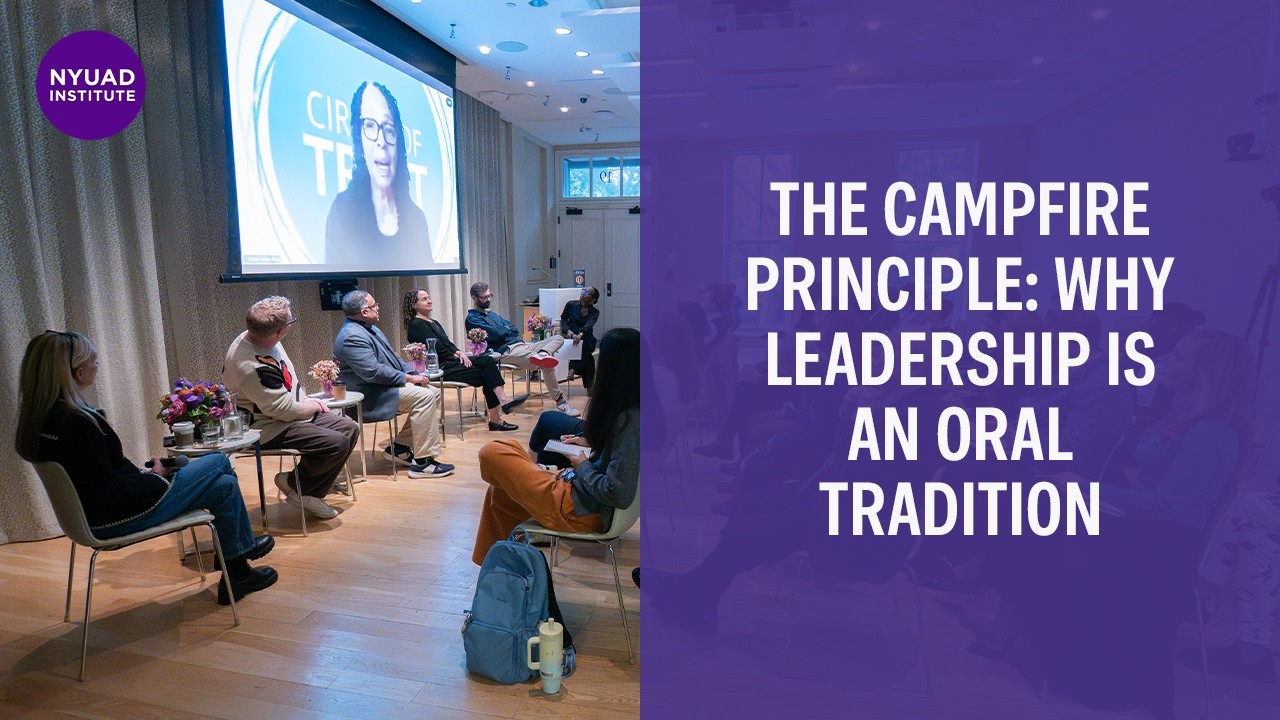
The Campfire Principle: Why Leadership Is an Oral Tradition
Title history
- The Campfire Principle: Why Leadership Is an Oral Tradition — observed on 20261025-1506 UTC (YouTube)
Keywords
Summary
126 words
Critical Evaluation
Value of the Information & Strength of the Argument
The value of the information lies in its authenticity and personal applicability. The panelists provide concrete examples of how they received and transmitted leadership wisdom, making abstract concepts tangible. The argumentation is based on anecdotal evidence and reflective practice, which is compelling for its humanistic approach but lacks empirical rigor. The stories illustrate the importance of vulnerability and intentionality in leadership, reinforcing the idea that leadership is relational rather than positional. The discussion is well-structured, with each panelist contributing distinct perspectives, and the moderators effectively synthesize the points to highlight common themes. While the arguments are persuasive in a narrative sense, they do not offer systematic analysis or evidence beyond personal testimonials.
Scientific Rigor, Source Quality, Title Accuracy
The discussion is based on the panelists’ personal experiences and their co-authored book, ‘Trinity of Leadership’, which is referenced but not heavily cited. The sources mentioned in the description are institutional links (NYUAD Institute, 19 WSN, mailing list) that provide context but no direct citations to external research. The title accurately captures the central thesis, and the content aligns with it. The panelists are credible given their academic and professional roles, but the conversation relies on anecdote rather than systematic research, limiting its scientific rigor. No external sources are critically examined, and the lack of empirical evidence weakens the overall reliability. The title and content are well matched, but the depth of scientific grounding is moderate.
243 words
Title / Content Match
The title accurately reflects the core theme of the discussion, which centers on storytelling and oral tradition as essential to leadership development.
Quality & Reliability
7/10
Panel of experienced academics and practitioners; discussion grounded in personal experience and professional reflection, though not empirically supported or critically analytical.
Key Moments
Markers derived by PSI from the transcript: the creator did not define chapters.
- Lydia Jadotte introduces the event and the panelists.
- Erica McGibbon sets the tone, highlighting the humanistic approach of the book.
- Dr. Nelson-Nash leads a guided reflection on a personal leadership story.
- Panelists share the first piece of leadership wisdom they received from a person, not a page.
- Discussion moves to the trinity of leadership, with panelists reflecting on which archetype they were at 25 and now.
Cited Sources
- NYUAD Institute — The event is hosted by NYUAD Institute; this link provides more information about the institute.
- 19 Washington Square North — The venue for the event, described in the introduction.
- NYUAD Institute Mailing List — Sign-up for updates on future events, mentioned in the description.
Concurring Sources
- NYUAD Institute — The institute supports the event and aligns with its mission of promoting scholarly exchange.
Contribution & Novelties
The video offers a refreshing perspective on leadership by emphasizing oral tradition and storytelling as core mechanisms for transmitting wisdom. It introduces the ’trinity of leadership’ (learners, thinkers, tinkerers) as a framework for understanding different leadership styles. The panelists’ personal stories provide concrete examples of how mentorship and narratives shape leadership development. The discussion challenges the conventional emphasis on formal training and metrics, advocating for a more human-centered approach.
Pour aller plus loin :
- Leadership — Overview of leadership theories and perspectives.
- Storytelling — Discusses the role of storytelling in human culture and communication.
- Mentorship — Explores the impact of mentors in professional and personal development.
- The concept of ‘oral tradition’ can be further explored on this Wikipedia page: Oral tradition .
122 words
Radar Profile
The radar profile shows moderate scores across quantity, quality, technical level, and reliability, indicating a balanced but not deeply technical discussion. The emphasis on personal narrative over empirical data is reflected in the moderate reliability score.