EMBL Keynote Lecture - Ubiquitin mediated regulation of transcription factor stability, Vishva Dixit
Title history
- EMBL Keynote Lecture - Ubiquitin mediated regulation of transcription factor stability, Vishva Dixit — observed on 20261026-0320 UTC (YouTube)
Keywords
Summary
194 words
Critical Evaluation
Value of the Information & Strength of the Argument
The value of this presentation lies in its novel mechanistic insight into acquired resistance to MAPK pathway inhibitors in melanoma. The argumentation is strong, based on a combination of clinical observations, genetic manipulation (knockouts, patient mutations), unbiased chemical screens, global proteomics, and transcriptomics. The speaker systematically demonstrates that COP1 mutations disrupt substrate binding, stabilize ETV5, and confer resistance specifically to MEK/ERK inhibitors. The use of rescue experiments (deleting ETV5) provides causal evidence. The argumentation is logical and well-supported by controls, though the work is unpublished and some aspects (like the dominant-negative effect) remain preliminary.
Scientific Rigor, Source Quality, Title Accuracy
Rigor is high: the talk includes multiple experimental approaches and controls, and the conclusions are drawn from quantitative data (growth curves, proteomics). The speaker cites several of his own published papers (e.g., Vitari et al. 2011, Suriben et al. 2015) that establish COP1’s role, and the unpublished work is presented with appropriate caution. The title accurately describes the content, focusing on ubiquitin-mediated regulation of transcription factor stability, and matches the presented material. No comments were analyzed as none were provided.
189 words
Title / Content Match
The title accurately reflects the content, focusing on ubiquitin-mediated regulation of transcription factor stability, specifically COP1 and ETV5.
Quality & Reliability
7/10
Presentation by a leading researcher from Genentech, based on unpublished data with references to published work. However, the talk presents preliminary results and lacks full experimental details, so a moderate-high score is given.
Key Moments
Markers derived by PSI from the transcript: the creator did not define chapters.
- Introduction and patient case with COP1 mutation leading to therapy resistance
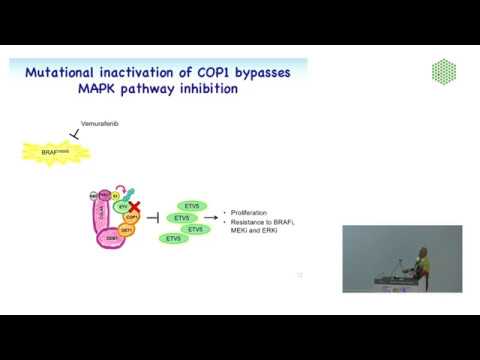
- Description of COP1 E3 ligase complex and its role in degrading ETS transcription factors
- Experiments showing ETV5 accumulation and degradation in response to MAPK inhibitors
- Unbiased screen and proteomics identifying ETV5 as major substrate and resistance driver
- RNA-seq analysis revealing downstream targets (SLUG, MITF) and conclusion
Cited Sources
- Human De-Etiolated-1 Regulates c-Jun by Assembling a CUL4A Ubiquitin Ligase (Wertz et al., Science 2004) — Reference [1] in description, foundational for COP1 complex
- COP1 is a Tumor Suppressor that Causes Deregulation of Proto-oncogenic ETS Transcription Factors (Vitari et al., Nature 2011) — Reference [2], establishes COP1's role in cancer
- β-cell insulin secretion requires the ubiquitin ligase COP1 (Suriben et al., Cell 2015) — Reference [3], additional COP1 function
Concurring Sources
- Vitari et al., Nature 2011 — Shows COP1 as tumor suppressor and regulates ETS factors, supporting the talk's foundational claims.
- Wertz et al., Science 2004 — Describes the COP1 complex and its regulation of c-Jun, complementary to mechanisms discussed.
Contribution & Novelties
The presentation offers a novel link between COP1 mutations, ETV5 stabilization, and resistance to BRAF/MEK inhibitors in melanoma. It demonstrates that post-translational regulation (via ubiquitin-mediated degradation) is a key mechanism for drug resistance, undetectable at the transcriptome level. The use of clinical samples, unbiased screens, and functional rescue experiments provides compelling evidence.
Pour aller plus loin :
- COP1 protein — Overview of COP1, including its role in plants and mammals.
- Ubiquitin-proteasome system — General mechanism of protein degradation.
- MAPK/ERK pathway — Signaling pathway targeted by inhibitors discussed.
- Transcription factor — Role of ETS factors in gene regulation.
- Melanoma — Disease context for the drug resistance studies.
106 words
Radar Profile
The radar profile shows high levels of technical expertise (9) and information quantity (8), reflecting the advanced molecular biology and comprehensive data presented. Quality and reliability scores are moderate (7) due to the unpublished nature of the work. Overall, the talk is scientifically robust but could benefit from peer review and further validation.