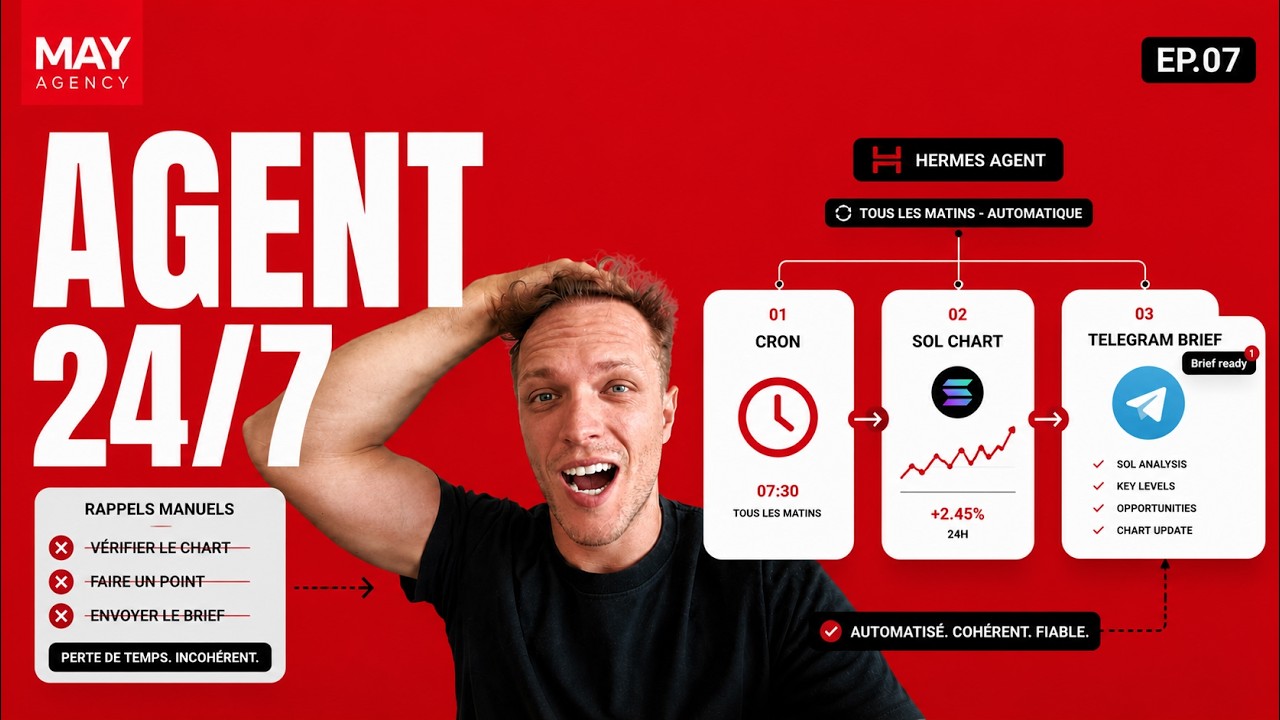
Dossier May Hermes: Cronjobs & Automatisations (Episode 7)
May Hermes File: Cronjobs & Automations (Episode 7)
Title history
- Dossier May Hermes: Cronjobs & Automatisations (Episode 7) — observed on 20261111-1954 UTC (YouTube)
Keywords
Summary
191 words
Critical Evaluation
Value of the Information & Strength of the Argument
The video offers practical value for users of the Hermes agent, providing clear step-by-step instructions and a realistic demo that illustrates the benefits of automation. The argumentation is coherent, grounded in the presenter’s own experience and the product’s documentation, emphasizing efficiency and token savings. However, the reasoning is largely anecdotal and product-specific, lacking comparative analysis or empirical tests. The logic that automation should be triggered by meaningful changes rather than fixed intervals is sound, but the video does not critically examine potential drawbacks or alternative approaches.
Scientific Rigor, Source Quality, Title Accuracy
The video is not scientific but technical, and it is rigorous within its scope. The source quality is limited: the only cited resources are the creator’s own website and a booking link, with no external references. The title accurately reflects the content, and the instructions are precise. The lack of independent corroboration and the promotional nature of the video reduce its overall scientific reliability. The creator mentions previous episodes in the series, which serves as internal context but not as external validation. The presentation is clear, and the steps are reproducible for users of the platform, but the absence of documentation links or official reference materials is a notable shortcoming.
211 words
Title / Content Match
The title clearly reflects the content, covering cron jobs and automations for the Hermes agent as promised.
Quality & Reliability
6/10
The video provides a practical, step-by-step tutorial on configuring cron jobs for a specific AI agent, but relies heavily on the creator's own product and personal experience without external scientific validation. Structured explanations and a live demo enhance reliability for its niche, yet the lack of independent sources and potential commercial bias cap the confidence.
Chapters
Cited Sources
- May Agent website — Official product website for Hermes agent
- Booking page — Link to book a discovery call with the creator
Contribution & Novelties
The video’s original contribution lies in its detailed, practical walkthrough of automating an AI agent using cron jobs, specifically within the Hermes ecosystem. It introduces advanced concepts like no_agent and wakeAgent for token optimization and demonstrates a multi-job pipeline for market analysis, which goes beyond basic tutorials. While the content is niche, it offers a concrete framework for designing autonomous agent workflows.
Pour aller plus loin :
- Cron (Unix) — Overview of the classic cron scheduling system, useful for understanding the fundamental concept.
- Intelligent agent — Background on AI agents and their autonomy, relevant to the Hermes agent discussed.
- Prompt engineering — Techniques for crafting effective prompts, directly applicable to the advice on making cron job prompts autonomous.
118 words
Radar Profile
The radar profile shows moderate scores across all dimensions, with quantity and technique slightly higher than reliability and quality. This reflects a solid but not exceptional tutorial that is informative and technically oriented, yet limited by its reliance on a single source and lack of external verification.