Hermes Agent Masterclass: Sub-agents (Episode 8)
Title history
- Hermes Agent Masterclass: Sub-agents (Episode 8) — observed on 20261111-1954 UTC (YouTube)
Keywords
Summary
145 words
Critical Evaluation
Value of the Information & Strength of the Argument
The video offers valuable practical knowledge on using sub-agents in the Hermes Agent framework, filling a niche for users needing to scale AI agent tasks. The argumentation is solid, based on the author’s experience and a live demonstration that effectively illustrates the concepts. The author clearly articulates the benefits (parallelism, context isolation) and the pitfalls (briefing quality, cost, non-persistence), making a compelling case for deliberate delegation. However, the reasoning relies on anecdotal evidence and the author’s own practices rather than systematic benchmarks or external research, which limits the generalizability of the claims.
Scientific Rigor, Source Quality, Title Accuracy
The video does not cite external scientific sources; instead, it points to the author’s website (may-agent.com) and a booking link for personalized advice, which are commercial rather than academic. The rigor is weak in terms of verifiable references, but the technical information about Hermes Agent’s configuration and behavior appears accurate based on the demonstration. The title matches the content precisely, being the eighth episode of a structured masterclass. No contradictory or concordant external sources are provided, and the video’s claims are not independently corroborated.
191 words
Title / Content Match
The title accurately reflects the content, a focused episode of the Hermes Agent masterclass discussing sub-agents in detail.
Quality & Reliability
7/10
The video is a practical tutorial with clear explanations and a live demonstration. However, it lacks rigorous citations and is based on the author's expert opinion rather than peer-reviewed sources, so reliability is moderate.
Key Moments
Markers derived by PSI from the transcript: the creator did not define chapters.
- Introduction to the episode and recap of previous topics.
- Discussion of limits of a single agent (time and context).
- Definition of sub-agents and the delegate_task function.
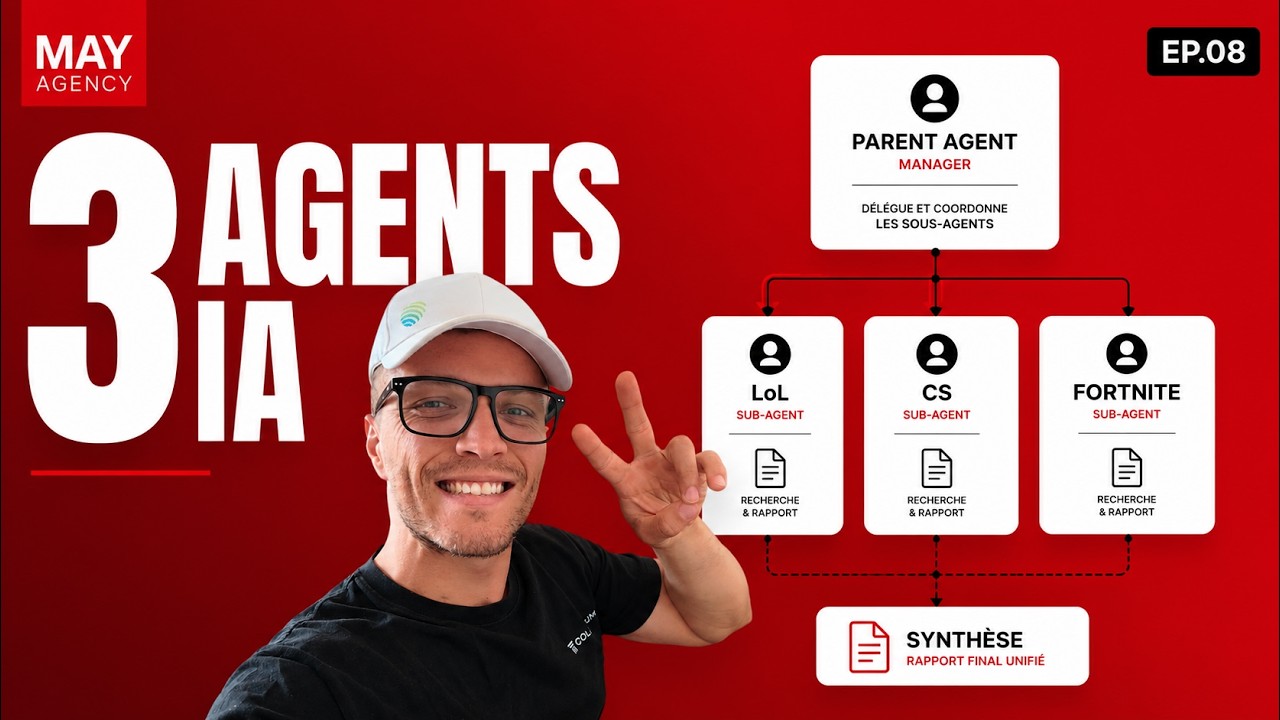
- Comparison between parent agent (manager) and child agents (researchers).
- When to use sub-agents: parallel independent tasks.
- When to avoid sub-agents: simple or durable tasks.
- Configuration of delegation settings in Hermes Dashboard.
- Live demo: parallel research on esports data (LoL, CS, Fortnite).
- Limitations of sub-agents: ignorance, non-persistence, cost, drift.
- Conclusion and preview of next episode on Kanban workflows.
Cited Sources
- May Agent - Discover the product — The official website for Hermes Agent, mentioned as a resource for users.
- Discovery call booking — Link provided by the author in the description for personalized consultation.
Contribution & Novelties
This video provides a practical, no-nonsense introduction to delegating tasks to sub-agents within the Hermes Agent framework, a topic not widely covered in such a structured way. The original contribution lies in the clear division between parent/child agents and the emphasis on writing precise briefs, illustrated with a realistic parallel research example. It also offers concrete configuration tips (model selection, timeout, iteration limits) that are directly actionable.
Pour aller plus loin :
- Multi-agent system — Provides academic background on multi-agent architectures and coordination.
- Large language model — Relevant to understanding the underlying technology of agents like Hermes.
- Task parallelism — Explains the concept of parallel task execution, which sub-agents exploit for efficiency.
112 words
Radar Profile
The radar profile shows balanced scores across information quantity, quality, technical level, and reliability, with a slight emphasis on quantity and technicality. This reflects a practical tutorial that is informative and moderately rigorous, offering technical depth without strong external validation.