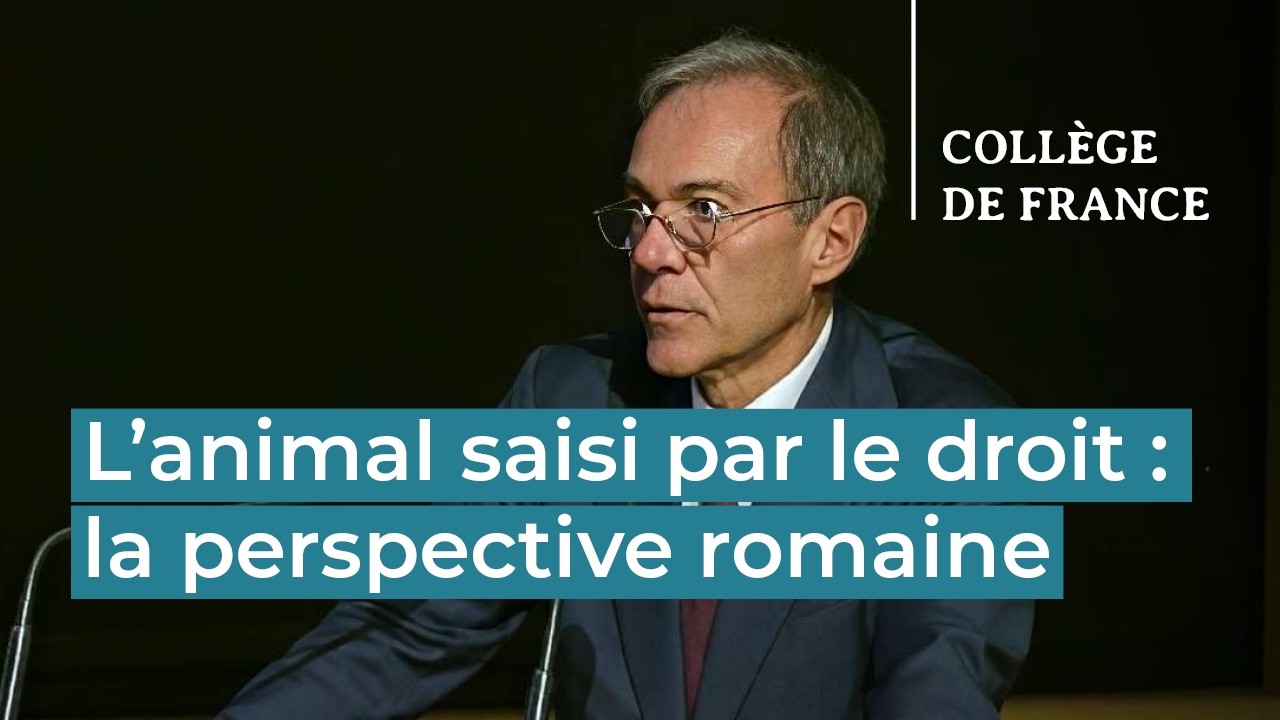
L’animal saisi par le droit : la perspective romaine - 2026-2027 (10)
The animal captured by law: the Roman perspective - 2026-2027 (10)
Keywords
Summary
211 words
Critical Evaluation
Value of the Information & Strength of the Argument
VALEUR DES INFORMATIONS & SOLIDITÉ DE L’ARGUMENTATION. The value lies in its innovative use of concrete, recent judicial decisions to anchor a historical analysis, making abstract legal categories tangible. The argumentation is rigorous; the speaker meticulously dissects the reasoning of the CJEU, exposing the unstated premise behind the legal syllogism. Similarly, his presentation of Ulpian’s texts is exegetic, showing precisely how the scala naturae was transcribed into law. The stepping-stone structure (modern case -> fiction -> philosophical background -> Roman technique -> modern application) builds a compelling, coherent case for the continuity of legal thought over two millennia. His use of analogies (furiosus, animal, tile) is academically sound, demonstrating a mastery of primary sources. The conclusion elegantly reframes the debate, proposing that human rights can serve as an instrument for nature’s protection, a nuanced position that acknowledges the anthropocentricity of current law while suggesting an evolution within that framework.
Scientific Rigor, Source Quality, Title Accuracy
RIGUEUR SCIENTIFIQUE, QUALITÉ DES SOURCES, ADÉQUATION TITRE/CONTENU. The scientific rigor is excellent. The speaker consistently references primary legal sources (Digest of Justinian, Ulpian, lex Aquilia, Code civil, Charte de l’environnement) and precise contemporary decisions (CJEU 16 Oct 2025, Conseil d’État 19 Feb 2026). These sources are accurately interpreted and their relevance to the argument is clearly established. The lecture is based on established historical and philological methods. The title, ‘The animal seized by law: the Roman perspective’, is perfectly adequate; the Roman perspective is not just mentioned but is the central analytical framework used to interpret modern cases. The depth of the source citations (especially the recent cases from 2025-2026) indicates a high level of academic currency. The institutional backing of the Collège de France further solidifies its reliability.
293 words
Title / Content Match
The title accurately captures the core theme: analyzing the animal's status in law through the lens of Roman legal history. The lecture consistently links contemporary judicial decisions back to Roman categories, making the title highly appropriate.
Quality & Reliability
9/10
Presentation by a renowned professor at a prestigious institution. He references specific, verifiable legal cases (CJEU, Conseil d'État), primary Roman legal sources (Digest, Ulpian), and cites his philosophical influences. The reasoning is transparent and methodologically sound, meeting the highest academic standards.
Key Moments
Markers derived by PSI from the transcript: the creator did not define chapters.
- Introduction of the case of a dog lost on a flight from Buenos Aires to Barcelona, raising the question of 'baggage' versus 'person'.
- Presentation of the Court of Justice of the EU ruling (16 Oct 2025) which classified the dog as 'baggage' based on an implicit premise that 'person' means 'human'.
- Introduction of Camille de Toledo's novel 'L'Internationale des rivières' and the fictional movement granting legal personality to ecosystems.
- Discussion of the main objections to the rights-of-nature movement, such as the practical difficulties of delimiting entities and choosing their legal representatives.
- Transition to the historical core: the etymology of 'natura' (from 'nascor') and the philosophical background of Aristotle and the Stoics.
- Exegesis of Ulpian's division of law into jus naturale, jus gentium, and jus civile, which mirrors the scala naturae.
- Analysis of the lex Aquilia case concerning a madman (furiosus), an animal, and a falling tile, demonstrating the Roman concept of legal subjectivity.
- Introduction of the modern approach using human rights as an instrument for protecting nature, referencing the French Charter for the Environment and a 2022 UN resolution.
- Presentation of the 'Tokyo' dog case, where the French Conseil d'État suspended an euthanasia order by invoking the owner's right to private life (19 Feb 2026).
- Conclusion: the continuity of legal categories from Roman times to the present, and the potential evolution towards protection without granting personhood to animals.
Cited Sources
- Colloque de rentrée 2026: L'animal — Official program and recordings of the colloquium where this lecture took place.
- Collège de France — Institutional website hosting the course and research resources.
- Convention de Montréal (1999) — International treaty on air transport, cited in the lecture as the legal framework defining baggage in the context of the dog lost in transit.
- Digest of Justinian (533 AD) — Primary Roman legal source containing Ulpian's text on the tripartite division of law, which is central to the lecture's historical argument.
- Charter for the Environment (France) — French constitutional text mentioned in the lecture as an instrument for protecting the environment through the right to a balanced environment.
External References
Contribution & Novelties
The original contribution of this lecture lies in its masterful ‘archaeology’ of a contemporary legal technique. By directly connecting a 2025 CJEU ruling and a 2026 Conseil d’État decision back to the categorical framework of Roman law, Mantovani demonstrates that the fundamental dichotomy between ‘person’ and ’thing’ is not a natural consequence of legal logic but a historically constructed premise rooted in a specific philosophical hierarchy. He reveals the unstated syllogism operating in judicial reasoning, showing how legal classification is a technique that inherently carries a worldview. Furthermore, his analysis of modern ‘rights of nature’ movements against the backdrop of Roman concepts of tutelage and human rights offers a novel synthesis for legal scholars, suggesting a path forward that preserves legal structure while expanding protection to non-human entities without necessarily granting them full legal personhood.
Pour aller plus loin :
- Scala naturae — Provides essential background on the Aristotelian and Stoic hierarchical conception of nature that the speaker argues underwrites Roman legal categories.
- Legal person — Central to the lecture’s core question of who can be a ‘subject of law’ and how this category is defined and extended.
- Rights of nature — Directly related to the contemporary legal movement and the fictional scenarios discussed by Mantovani in the second half of the lecture.
- Lex Aquilia — The Roman law statute on damages, whose interpretation by Ulpian (regarding madmen, animals, and tiles) is a key example in the lecture’s analysis.
239 words
Radar Profile
Given the scores, the profile reveals a high-quality, dense scholarly lecture ('qualite_information' 9, 'niveau_technique' 8) with a very high reliability ('fiabilite_globale' 9). The lower 'quantite_information' (8) reflects that while rich in examples, it is a single, focused theoretical argument rather than an exhaustive encyclopedic survey. Overall, a well-balanced, expert-level presentation.